Section 1: Introduction
Traditional CDL Testing Study Guide
1. Introduction
There is a federal requirement that each state have minimum standards for the licensing of commercial drivers.
This manual provides driver license testing information for drivers who wish to have a commercial driver license (CDL). This manual does NOT provide information on all the federal and state requirements needed before you can drive a commercial motor vehicle (CMV). You may have to contact your state driver licensing authority for additional information.
You must have a CDL to operate:
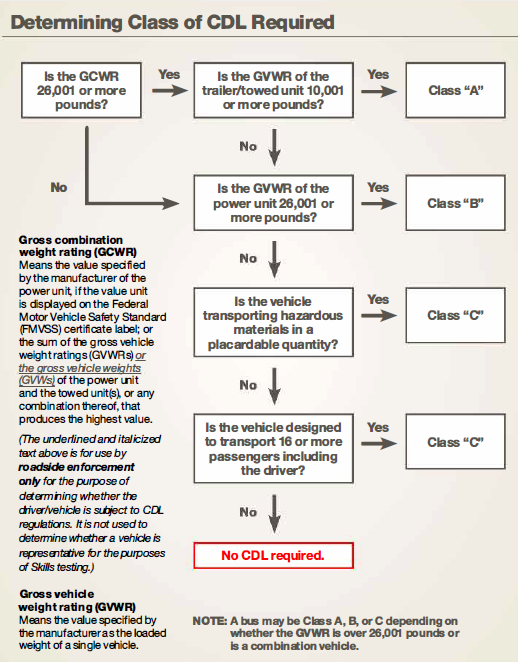
- Any single vehicle with a gross vehicle weight rating (GVWR) of 26,001 pounds or more.
- A combination vehicle with a gross combination weight rating of 26,001 or more pounds, provided the GVWR of the vehicle(s) being towed is in excess of 10,000 pounds.
- A vehicle designed to transport 16 or more passengers (including the driver).
- Any size vehicle which requires hazardous material placards or is carrying material listed as a select agent or toxin in 42 CFR part 73. Federal regulations through the Department of Homeland Security require a background check and fingerprinting for the Hazardous Materials endorsement. The background check can take up to six weeks. Contact the Transportation Security Administration (TSA) at https://universalenroll.dhs.gov or your local DDS Customer Service Center for more information.
To get a CDL, you must pass knowledge and skills tests. This manual will help you pass the tests. This manual is not a substitute for a truck driver training class or program. Formal training is the most reliable way to learn the many special skills required for safely driving a large commercial vehicle and becoming a professional driver in the trucking industry. Figure 1.1 helps you determine if you need a CDL.
Figure 1.1
1.1 General qualification of drivers:
- Is at least 18 years old;
- Can read and speak the English language sufficiently to converse with the general public to understand highway traffic signs and signals in the English language, to respond to official inquiries, and to make entries on reports and records;
- Can, by reason of experience, training, or both, safely operate the type of commercial motor vehicle he and / or she drives;
- Is physically qualified to drive a commercial motor vehicle in accordance with CFR 391.41;
- Has a currently valid Commercial Learner's Permit (CLP) or CDL issued by only one State or jurisdiction; and
- Is not disqualified to drive a commercial motor vehicle.
1.2 Commercial Driver License Tests
1.2.1 Knowledge Tests
A Commercial Learner's Permit (CLP) means a permit issued to an individual, which, when carried with a valid driver's license issued by the same State or jurisdiction, authorizes the individual to operate a class of a commercial motor vehicle when accompanied by aholder of a valid CDL for purposes of behind-the-wheel training.
When issued to a CDL holder, a CLP serves as authorization for accompanied behind-the-wheel training in a commercial motor vehicle for which the holder's current CDL is not valid.
A CLP is considered a valid CDL for purposes of behind-the-wheel training on public roads or highways, if all of the following minimum conditions are met:
- The CLP holder is at all times accompanied by the holder of a valid CDL who has the proper CDL group and endorsement(s) necessary to operate the CMV.
- The CDL holder must at all times be physically present in the front seat of the vehicle next to the CLP holder or, in the case of a passenger vehicle, directly behind or in the first row be hind the driver and must have the CLP holder under observation and direct supervision.
The issuance of a CLP is a precondition to the initial issuance of a CDL. The issuance of a CLP is also a precondition to the upgrade of a CDL if the upgrade requires a skills test. The CLP holder is not eligible to take the CDL skills test in the first 14 days after initial issuance of the CLP. If you change CLP Class or add one of 3 endorsements (P-S-N) your initial issuance changes.
Each person applying for a commercial or non-commercial instructional (learner's) permit for Class A, B, C, or M driver's license shall pay the applicable license fee prior to attempting the knowledge test for the instructional (learner's) permit sought. If said person fails to achieve a passing score on the knowledge test, the license fee paid shall be considered a testing fee and retained by the department. Any person failing to achieve a passing score on the knowledge test for an instructional (learner's) permit shall pay the applicable license fee on each subsequent attempt until successful, at which time the fee shall be his or her license fee.
You will have to take one or more knowledge tests, depending on what class of license and what endorsements you need. To qualify for a license permit, a person must obtain a passing score on all knowledge tests required for that class. The CDL knowledge tests are all multiple choice and include:
- The general knowledge test, taken by all applicants.
- The passenger transport test, taken by all bus driver applicants. The passenger transport skills test must be taken and passed by all applicants in order to obtain this endorsement.
- The air brakes test, which you must take if your vehicle has air brakes, including air over hydraulic brakes.
- The combination vehicles test, which is required if you want to drive combination vehicles.
- The hazardous materials test, required if you want to haul hazardous materials, as defined in 49 CFR 383.5. In order to obtain this endorsement you are also required to pass a Transportation Security Administration (TSA) background check (go to https://universalenroll.dhs.gov for additional information). (NOTE: This endorsement is not eligible to be on the CLP.)
- The tanker test is required if you want to haul a liquid or gaseous materials in a tank or tanks having an individual rated capacity of more than 119 gallons and an aggregate rated capacity of 1,000 gallons or more that is either permanently or temporarily attached to the vehicle or chassis.
- Note: Since 2/7/22 Formal Training is required before you will be able to get the TSA background check.
- The doubles and / or triples test, required if you want to pull double or triple trailers. (NOTE: This endorsement is not eligible to be on the CLP.)
- The School Bus test is required if you want to drive a school bus. The school bus skills test must be taken and passed by all applicants in order to obtain this endorsement.
The passing score for all knowledge test is 80%.
With the exception of adding the Passenger (P) endorsement or the School Bus (S) endorsement, a driver who already has the required license class may add the endorsement(s) after passing written tests requisite to the endorsement(s) being applied for. To obtain a Passenger (P) or School Bus (S) endorsement, the driver must pass both CDL knowledge and skills tests.
If you do not have the license class require for an endorsement but are seeking that class while also seeking the endorsement, the endorsement is only granted if the knowledge test for the endorsement is passed and all other requirements for the license class are met.
If you fail an endorsement test, but have otherwise passed the knowledge tests for the license class, you can still take the applicable skills tests. If you pass the skills tests, you should be given the appropriate license, but without the endorsement. You can then retake the endorsement test later without further skills testing except for obtaining a P or S endorsement (P and S endorsements require a skills test be performed in a bus).
Upon request the examiner will provide you with your score for each knowledge test taken. All test material is derived from the CDL Drivers Manual.
After you have passed the knowledge test(s) for a license class, you then must pass the skill tests. No class of CDL or CDL upgrade is granted solely on the basis of passing the knowledge tests. If a driver fails one or more of the knowledge tests required for a license class, you must retake and pass the failed test(s) before taking the skills tests.
The retest waiting period is:
- 1st failure and subsequent failures - two days
Knowledge test failures also affect the retest waiting period for skills test.
Current active Duty Military, Guard and Reserve members or military personnel that have not been out of the military more than one (1) year can apply for a Military Skills Test Waiver. Please visit the DDS website at dds.georgia.gov to download the Military Skills Test Waiver application.
Section 1 Continued
1.2.2 Skills Tests
Each person applying for a Class A, B, or C commercial driver's license shall pay the applicable license fee at the time that he or she schedules his or her appointment for said skills test. If said person fails to appear for his or her scheduled skills test appointment the license fee paid shall be considered a testing fee and retained by the department. Pursuant to O.C.G.A. §40-5-25 and DDS Rule 1-1-.10(7), the $50.00 Commercial Driver's License (CDL) Road Skills Test fee is now required for each testing attempt. All fees retained by the department pursuant to this Code section shall be remitted to the general fund.
If you pass the required knowledge test(s), You can take the CDL roadtest. Here are three types of general skills that will be tested:
- pre-trip inspection;
- basic vehicle control; and
- on-road driving.
You must take these tests in the type of vehicle for which you wish to be licensed. Any vehicle that has components marked or labeled cannot be used for the Pre-trip inspection test.
You are required to complete Entry Level Driver Training (ELDT) before being allowed to take the CDL Skills tests. The CLP cannot be held for more than one year (365) days. If you fail any part of the skills tests you can apply to reschedule the retest after the waiting period as follows:
- 1st failure and subsequent failures - two days
The following restrictions will be placed on your license if the test is this type of vehicle:
- If an applicant performs the skills test in a vehicle equipped with an automatic transmission, that person is restricted from operating a CMV equipped with a manual transmission. (No manual transmission equipped CMV)
- Tractor-trailer - If an applicant performs the skills test in a combination vehicle for a Group A CDL with the power unit and towed unit connected with a pintle hook or other non-fifth wheel connection, that person is restricted from operating a tractor-trailer combination connected by a fifth wheel that requires a Group A CDL. (No tractor trailer CMV)
- If an applicant performs the skills test in a passenger vehicle requiring a Group B CDL, that person is restricted from operating a passenger vehicle requiring a Group A CDL. (No Class A passenger busses)
- If an applicant performs the skills test in a passenger vehicle requiring a Group C CDL, that person is restricted from operating a passenger vehicle requiring a Group B CDL. (No class A or B passenger busses)
- If an applicant performs the skills test in a vehicle that does not have air brakes they will be restricted from operating a CMV with air brakes. (No air brake equipped CMV)
To have a restriction(s) removed you must obtain a CLP for the Class of vehicle you will be operating that does not have the restriction(s) on it. The permit is considered valid for purposes of behind-the-wheel training on public roads or highways if at all times accompanied by the holder of a valid CDL who has the proper CDL group and endorsement(s) necessary to operate the CMV. The CDL holder must at all times be physically present in the front seat of the vehicle next to the CLP holder or, in the case of a passenger vehicle, directly behind or in the first row behind the driver and must have the CLP holder under observation and direct supervision. You will also be required to take the road test (i.e. vehicle inspection, basic skills and on the-road driving test) again in a vehicle that is not configured and / or equipped the same as the one that resulted in the restriction(s) originally being placed on the license.
Pre-trip Inspection
You will be tested to see if you know whether your vehicle is safe to drive. You will be asked to do a pre-trip inspection of your vehicle and explain to the examiner what you would inspect and why. (This will require you to physically maneuver and / or crawl under the hood or under the vehicle.)
Basic Vehicle Control.
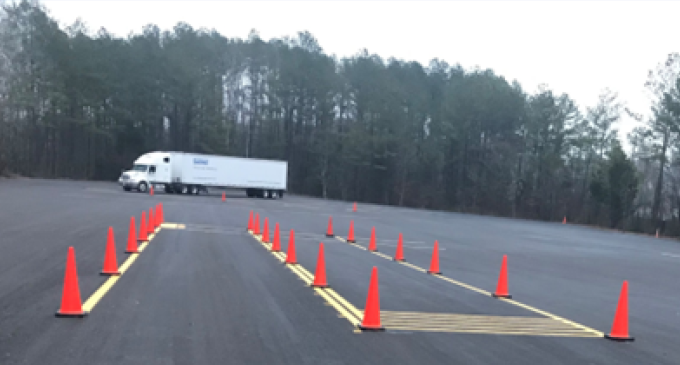
You will be tested on your skill to control the vehicle. You will be asked to move your vehicle forward, backward, and turn it within a defined area. These areas may be marked with traffic lanes, cones, barriers, or something similar. The examiner will tell you how each control test is to be done.
On-road Test
You will be tested on your skill to safely drive your vehicle in a variety of traffic situations. The situations may include left and right turns, intersections, railroad crossings, curves, up and down grades, single or multi lane roads, streets, or highways. The examiner will tell you where to drive.
Figure 1.2 details which sections of this manual you should study for each particular class of license and for each endorsement.
| Sections to Study | Class A | Class B | Class C |
|---|---|---|---|
| 1 | Yes | Yes | Yes |
| 2 | Yes | Yes | Yes |
| 3 | Yes | Yes | Yes |
| 4 | No | No | No |
| 5 (study this section if you plan to operate vehicles equipped with air brakes) | Yes | Yes | Yes |
| 6 | Yes | No | No |
| 7 | No | No | No |
| 8 | No | No | No |
| 9 | No | No | No |
| 10 | No | No | No |
| 11 | Yes | Yes | Yes |
| 12 | Yes | Yes | Yes |
| 13 | Yes | Yes | Yes |
| Sections to Study | Hazardous Materials | Double and / or Triple | Tank Vehicles | Passenger | School Bus |
|---|---|---|---|---|---|
| 1 | No | No | No | No | No |
| 2 | No | Yes | Yes | Yes | No |
| 3 | No | No | No | No | No |
| 4 | No | No | No | Yes | No |
| 5 (study this section if you plan to operate vehicles equipped with air brakes) | No | Yes | No | No | No |
| 6 | No | Yes | Yes | No | No |
| 7 | No | Yes | No | No | No |
| 8 | No | No | Yes | No | No |
| 9 | Yes | No | Yes | No | No |
| 10 | No | No | No | No | Yes |
| 11 | No | No | No | Yes | Yes |
| 12 | No | No | No | Yes | Yes |
| 13 | No | No | No | Yes | Yes |
Section 1.3
1.3 CDL Disqualifications
1.3.1 General
You may not drive a commercial motor vehicle if you are disqualified for any reason.
1.3.2 Alcohol, Leaving the Scene of an Accident, and Commission of a Felony
It is illegal to operate a CMV if your blood alcohol concentration (BAC) is .04% or more. If you operate a CMV, you shall be deemed to have given your consent to alcohol testing.
You will lose your CDL for at least one year for a first offense for:
- Driving a CMV if your blood alcohol concentration is .04% or higher.
- Driving a CMV under the influence of alcohol.
- Refusing to undergo blood alcohol testing.
- Driving a CMV while under the influence of a controlled substance.
- Leaving the scene of an accident involving a CMV.
- Committing a felony involving the use of a CMV.
- Driving a CMV when the CDL is suspended.
- Causing a fatality through negligent operation of a CMV.
You will lose your CDL for at least three years if the offense occurs while you are operating a CMV that is placarded for hazardous materials.
You will lose your CDL for life for a second offense.
You will lose your CDL for life if you use a CMV to commit a felony involving controlled substances.
You will be put out-of-service for 24 hours if you have any detectable amount of alcohol under .04%.
1.3.3 Serious Traffic Violations
Serious traffic violation means conviction of any of the following offenses or a conviction of any law or ordinance equivalent thereto in this state, in any other state, or in any foreign jurisdiction, when operating either a commercial motor vehicle or unless otherwise specified, a non-commercial vehicle:
Serious traffic violations are excessive speeding (15 mph or more above the posted limit), reckless driving, improper or erratic lane changes, following a vehicle too closely, traffic offenses committed in a CMV in connection with fatal traffic accidents, driving a CMV without obtaining a CDL or having a CDL in the driver's possession, and driving a CMV without the proper class of CDL and / or endorsements.
You will lose your CDL:
- For at least 60 days if you have committed two serious traffic violations within a three year period.
- For at least 120 days if convicted of a third or subsequent serious traffic violation.
1.3.4 Violation of Out-of-Service Orders
You will lose your CDL:
- For at least 180 days if you have committed your first violation of an out-of-service order.
- For at least two years if you have committed two violations of out-of-service orders in separate incidences.
- For at least three years if you have committed three or more violations of an out-of-service order.
1.3.5 Railroad-highway Grade Crossing Violations
You will lose your CDL:
- For at least 60 days for your first violation.
- For at least 120 days for your second violation within a three-year period.
- For at least one year for your third violation within a three-year period.
These violations include violation of a federal, state or local law or regulation pertaining to one of the following six offenses at a railroad highway grade crossing:
- For drivers who are not required to always stop, failing to stop before reaching the crossing if the tracks are not clear.
- For drivers who are not required to always stop, failing to slow down and check that the tracks are clear of an approaching train.
- For drivers who are always required to stop, failing to stop before driving onto the crossing.
- For all drivers failing to have sufficient space to drive completely through the crossing without stopping.
- For all drivers failing to obey a traffic control device or the directions of an enforcement official at the crossing.
- For all drivers failing to negotiate a crossing because of insufficient undercarriage clearance.
1.3.6 Hazardous Materials Endorsement Background Check and Disqualifications
If you require a hazardous materials endorsement you will be required to submit your fingerprints and be subject to a background check. You will be denied or you will lose your hazardous materials endorsement if you:
- Are not a lawful permanent resident of the United States.
- Renounce your United States citizenship.
- Are wanted or under indictment for certain felonies.
- Have a conviction in military or civilian court for certain felonies.
- Have been adjudicated as a mental defective or committed to a mental institution.
- Are considered to pose a security threat as determined by the Transportation Security Administration.
The background check procedures vary from jurisdiction to jurisdiction. Your licensing agency will provide you with all the information you need to complete the required TSA background check procedures. (The TSA website can provide additional information)
1.3.7 Traffic Violations in Your Personal Vehicle
The Motor Carrier Safety Improvement Act (MCSIA) of 1999 requires a CDL holder to be disqualified from operating a commercial motor vehicle if the CDL holder has been convicted of certain types of moving violations in their personal vehicle.
If your privilege to operate your personal vehicle is revoked, cancelled, or suspended due to violations of traffic control laws (other than parking violations) you will also lose your CDL driving privileges.
If your privilege to operate your personal vehicle is revoked, cancelled, or suspended due to alcohol, controlled substance or felony violations, you will lose your CDL for 1 year. If you are convicted of a second violation in your personal vehicle or CMV you will lose your CDL for life.
If your license to operate your personal vehicle is revoked, cancelled, or suspended you may not obtain a "hardship" license to operate a CMV.
1.3.8 Major Traffic Violations
You will be disqualified from driving a CMV for not less than one year if convicted of any of the following offenses when operating either a commercial motor vehicle or, unless otherwise specified, a non-commercial motor vehicle:
- Driving a vehicle under the influence in violation of Code Section 40-6-391.
- Hit and run or leaving the scene of an accident; failing to report striking an unattended vehicle, failure to report striking a fixed object, or failure to report an accident.
- Any felony in the commission of which a motor vehicle is used.
- Driving a commercial motor vehicle while the person's commercial driver's license or commercial driving privilege is revoked, suspended, canceled, or disqualified.
- Homicide by vehicle.
- Racing on highways or streets.
- Using a motor vehicle in fleeing or attempting to elude an officer.
- Fraudulent or fictitious use of, or application for, a license.
- Operating a motor vehicle with a revoked, canceled, or suspended registration.
- Theft of a vehicle engaged in commercial transportation of cargo or any appurtenance thereto or the cargo being transported therein or thereon.
- Refusing to submit to a state administered chemical test requested by a law enforcement officer.
- Using a CMV in the commission of a felony involving trafficking of persons (Permanent, lifetime disqualification)
If one of these offenses above occurs while you are operating a CMV that is placarded for hazardous materials, you will be disqualified from driving a CMV for at least three years.
You will be disqualified from driving a commercial motor vehicle for life if convicted of a second or subsequent major traffic violation or any combination of such violations from the list under the heading "Major Traffic Violations".
Section1.3.9
1.3.9 Georgia Traffic Laws
When the department determines a road shall have limited access due to a declared state of emergency for inclement winter weather conditions, notice shall be given to motorists through posted signage that motor vehicles must be equipped with tire chains, four-wheel drive with adequate tires for existing conditions, or snow tires with a manufacturer's all weather rating in order to proceed.
Commercial motor vehicles shall affix tire chains to each of the outermost drive wheel tires. Bus and motor coach operators shall affix tire chains to at least two of the drive wheel tires before proceeding on a road with limited access due to a declared state of emergency for inclement winter weather conditions.
A driver of a motor vehicle who causes an accident or blocks the flow of traffic while failing to comply with the requirements of this code section shall be fined up to $1,000.00.
- Commercial Motor Vehicles and any other motor vehicle with more than six wheels is prohibited from traveling along GA 400 and interstate routes inside I-285 unless the driver of such motor vehicle is:
- Engaging in a pick up or delivery to or from a shipper located inside the arc of Interstate 285
- Traveling to or from such motor vehicle's terminal facility located inside the arc of Interstate 285
- Traveling to or from a repair facility located inside the arc of Interstate 285 for service; or
- Traveling to or from his or her residence which is located inside the arc of Interstate 285.
- Cargo theft - GA Code 16-8-22:
- (a) For purposes of this Code section, the term "vehicle" includes, without limitation, any railcar.
- (b) Notwithstanding any provision of this article to the contrary, a person commits the offense of cargo theft when he or she unlawfully takes or, being in lawful possession thereof, unlawfully appropriates:
- Any vehicle engaged in commercial transportation of cargo or any appurtenance thereto, including, without limitation, any trailer, semitrailer, container, or other associated equipment, or the cargo being transported therein or thereon, which is the property of another with the intention of depriving such other person of the property, regardless of the manner in which the property is taken or appropriated; or
- Any trailer, semitrailer, container, or other associated equipment, or the cargo being transported therein or thereon, which is deployed by or used by a law enforcement agency, which is the property of another with the intention of depriving such other person of the property, regardless of the manner in which the property is taken or appropriated.
- (c) The value of a vehicle engaged in commercial transportation of cargo and any appurtenance thereto and the cargo being transported which is taken or unlawfully appropriated shall be based on the fair market value of such vehicle, appurtenances, and cargo taken or unlawfully appropriated.
- (d)
- If the property taken is one or more controlled substances as defined in Code Section 16-13-21 with a collective value of less than $10,000.00, a person convicted of a violation of this Code section shall be punished by imprisonment for not less than one nor more than ten years, a fine of not less than $10,000.00 nor more than $100,000.00, or both.
- If the property taken is one or more controlled substances as defined in Code Section 16-13-21 with a collective value of at least $10,000.00 but less than $1 million, a person convicted of a violation of this Code section shall be punished by imprisonment for not less than five nor more than 25 years, a fine of not less than $50,000.00 nor more than $1 million, or both.
- If the property taken is one or more controlled substances as defined in Code Section 16-13-21 with a collective value of $1 million or more, a person convicted of a violation of this Code section shall be punished by imprisonment for not less than ten nor more than 30 years, a fine of not less than $100,000.00 nor more than $1 million, or both.
- (e)
- Except as otherwise provided in subsection (d) of this Code section, if the property taken has a collective value of $1,500.00 or less, a person convicted of a violation of this Code section shall be punished as for a misdemeanor.
- Except as otherwise provided in subsection (d) of this Code section, if the property taken has a collective value of more than $1,500.00 but less than $10,000.00, a person convicted of a violation of this Code section shall be punished by imprisonment for not less than one nor more than ten years, a fine of not less than $10,000.00 nor more than $100,000.00, or both.
- Except as otherwise provided in subsection (d) of this Code section, if the property taken has a collective value of at least $10,000.00 but less than $1 million, a person convicted of a violation of this Code section shall be punished by imprisonment for not less than five nor more than 20 years, a fine of not less than $50,000.00 nor more than $1 million, or both.
- Except as otherwise provided in subsection (d) of this Code section, if the property taken has a collective value of $1 million or more, a person convicted of a violation of this Code section shall be punished by imprisonment for not less than ten nor more than 20 years, a fine of not less than $100,000.00 not more than $1 million, or both.
- (f) Notwithstanding subsections (d) and (e) of this Code section, if the property taken is a trailer, semitrailer, container, or other associated equipment, or the cargo being transported therein or thereon, which is deployed by or used by a law enforcement agency, regardless of its value, a person convicted of a violation of this Code section shall be punished by imprisonment for not less than one nor more than ten years, a fine of not less than $10,000.00 nor more than $100,000.00, or both.
- (g) A person convicted of a violation of this Code section may also be punished by, if applicable, the revocation of the defendant's commercial driver's license in accordance with Code Section 40-5-151.
| Type | Term | Fee |
|---|---|---|
| CDL License Class A and B | 8 years | $32 |
| CDL Learner's Permit AP and BP | 365 days | $10 |
| CDL Application | $35 | |
| CDL Road Skills Test (After February 7, 2022, applicants must complete ELDT before taking a road skills test or the Hazmat endorsement knowledge exam |
$50 | |
| CDL Endorsements | "Term of License without Hazmat" | $5 each |
Note: If you possess a Hazmat Endorsement, it will expire on the Threat Assessment Date which is a maximum of 5 years.
| Class | Purpose |
|---|---|
| Class A | Truck trailer or tractor-semi trailer combination in which the combination weight exceeds 26,001 pounds and the unit being towed exceeds 10,000 pounds. Class A driver may operate vehicles in Class B and C with required endorsements. Applicants must possess a Class C driver's license before obtaining a Class A and be at least 18 years of age. A single driver's license, with a combination of classifications, will be issued to qualified persons who wish to drive various types of vehicles. |
| Class AP | Class A Commercial Learner's Permit |
| Class B | Single vehicles weighing 26,001 or more pounds and the unit being towed is less than 10,000 pounds. A Class B driver may operate motor vehicles included within Class C. Applicants must possess a Class C driver's license prior to obtaining a Class B driver's license and be at least 18 years of age. |
| Class BP | Class B Commercial Learner's Permit |
| Class C | Class 'C' Commercial Driver's Licenses are issued only if the vehicle is designed to transport sixteen or more passengers (including the driver), or utilized to transport hazardous materials in quantities that require placarding. |
| E | No Manual Transmission Equipped CMV |
|---|---|
| K | Intrastate Commerce Only |
| L | Without Air-Brakes |
| M | No Class A Passenger Buses |
| N | No Class A or B Passenger Buses |
| O | No Tractor Trailer CMV |
| P | No Passengers in CMV bus |
| V | Medical Variance |
| X | No Cargo in CMV Tank Vehicle |
| Y | Hearing Aid Required |
| Z | No Full Air Brake |
| C | For-Hire |
|---|---|
| P | Passenger Vehicles (sixteen or more, including driver) |
| T | Double and / or Triple-Trailers |
| X | Tanker and Hazardous (not qualified for Permits) |
| H | Hazardous Materials Haulers (not qualified for Permits) |
| S | School Bus |
| N | Tank Vehicles |
The "Move Over" Law
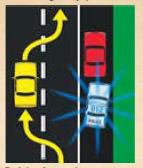 CaptionSafely change lanes when approaching any emergency, sanitation, or utility service vehicle.
Georgia's "Move Over" Law helps ensure highway safety for motorists, emergency personnel, active sanitation workers, and utility service workers when their vehicles are stopped on the side of the roadway.
This law was created to reduce the number of injuries and fatalities to police officers, paramedics, firefighters, wrecker operators, and highway maintenance workers by maintaining an open buffer lane between passing highway traffic and authorized roadside emergency vehicles displaying flashing yellow, amber, white, red, or blue lights. It was amended to include active sanitation workers and utility service workers who are utilizing traffic cones and / or vehicles displaying flashing lights.
In Georgia, this law requires motorists to:
- Move Over to the next lane if safely possible;
- If unable to Move Over, then Slow Down below the speed limit and be prepared to stop.
This law applies to any emergency vehicle, sanitation, or utility service parked on the shoulder of the roadway.
Why was the "Move Over" Law Passed?
- Because it saves lives. The "Move Over" Law helps maintain traffic flow and protect the safety of motorists, emergency personnel, active sanitation workers, and utility service workers.
- Vehicles parked on the side of the roadway are vulnerable to crashes even when emergency lights are flashing.
- More police officers are killed by traffic crashes than in any other line-of-duty cause of death. More than one fourth of those killed are struck by passing vehicles while they work outside their patrol cars.

How does the "Move Over" Law make a difference?
- Thirty percent of all crashes occur as the result of another crash.
- Providing a buffer lane for these vehicles parked on the roadway shoulder actually reduces the risk of another crash.
- When the required clearance is given to roadside these types of vehicles, the margin of safety is increased, not only for public safety, emergency personnel, active sanitation workers, and utility service workers, but for motorists and their passengers as well.
It's the Law!
- Violations can result in a fine of no more than $500 for the first offense.
- The "Move Over" Law is another reason to slow down on the highways and, interstates, and roadways.
Section 1.4
1.4 Other CDL Rules
There are other federal and state rules that affect drivers operating CMVs in all states. Among them are:
- You cannot have more than one license. If you break this rule, a court may fine you up to $5,000 or put you in jail
- You must notify your employer within 30 days of conviction for any traffic violations (except parking). This is true no matter what type of vehicle you were driving.
- You must notify your motor vehicle licensing agency within 30 days if you are convicted in any other jurisdiction of any traffic violation (except parking). This is true no matter what type of vehicle you were driving.
- You must notify your employer within two business days if your license is suspended, revoked, or canceled, or if you are disqualified from driving.
- You must give your employer information on all driving jobs you have held for the past 10 years. You must do this when you apply for a commercial driving job.
- No one can drive a commercial motor vehicle without a CDL. A court may fine you up to $5,000 or put you in jail for breaking this rule.
- If you have a hazardous materials endorsement you must notify and surrender your hazardous materials endorsement to the state that issued your CDL within 24 hours of any conviction or indictment in any jurisdiction, civilian or military, for, or found not guilty by reason of insanity of a disqualifying crime listed in 49 CFR 1572.103; who is adjudicated as a mental defective or committed to a mental institution as specified in 49 CFR 1572.109; or who renounces his or her U. S. citizenship;
- Your employer may not let you drive a commercial motor vehicle if you have more than one license or if you're CDL is suspended or revoked. A court may fine the employer up to $5,000 or put him or her in jail for breaking this rule.
- All states are connected to one computerized system to share information about CDL drivers. The states will check on drivers' accident records to be sure that drivers do not have more than one CDL.
You must be properly restrained by a safety belt at all times while operating a commercial motor vehicle. The safety belt design holds the driver securely behind the wheel during a crash, helping the driver to control the vehicle and reduces the chance of serious injury or death. If you do not wear a safety belt, you are four times more likely to be fatally injured if you are thrown from the vehicle.
You are not allowed to hold a mobile telephone to conduct a voice communication or dial a mobile telephone by pressing more than a single button when driving.
You are not allowed to send or read text messages while driving.
Penalties for False Information
Pursuant to 49 CFR 383.73G), if a State determines, in its check of an applicant's license status and record prior to issuing a CLP or CDL, or at any time after the CLP or CDL is issued, that the applicant has falsified information contained in subpart J of this part, in any of the certifications required in§ 383.71(b) or (g), or in any of the documents required to be submitted by§ 383.71(h), the State must at a minimum disqualify the person's CLP or CDL or his and / or her pending application, or disqualify the person from operating a commercial motor vehicle for a period of at least 60 consecutive days.
Pursuant to 49 CFR 383.73(k)(l), the State must have policies in effect that result, at a minimum, in the disqualification of the CLP or CDL of a person who has been convicted of fraud related to the issuance of that CLP or CDL. The application of a person so convicted who seeks to renew, transfer, or upgrade the fraudulently obtained CLP or CDL must also, at a minimum, be disqualified. The State must record any such withdrawal in the person's driving record. The person may not reapply for a new CDL for at least 1 year.
Pursuant to 49 CFR 383.73(k)(2), if a State receives credible information that a CLP- or CDL-holder is suspected, but has not been convicted, of fraud related to the issuance of his and / or her CLP or CDL, the State must require the driver to re-take the skills and / or knowledge tests. Within 30 days of receiving notification from the State that re-testing is necessary, the affected CLP- or CDL-holder must make an appointment or otherwise schedule to take the next available test. If the CLP- or CDL-holder fails to make an appointment within 30 days, the State must disqualify his and / or her CLP or CDL. If the driver fails either the knowledge or skills test or does not take the test, the State must disqualify his and / or her CLP or CDL. Once a CLP- or CDL-holder's CLP or CDL has been disqualified, he and / or she must reapply for a CLP or CDL under State procedures applicable to all CLP and CDL applicants.
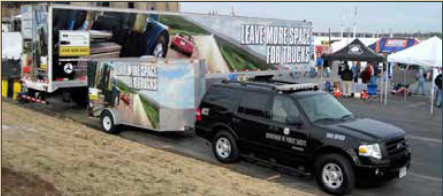
Georgia Targeting Aggressive Cars and Trucks (GTACT)
The Georgia Department of Public Safety, Motor Carrier Compliance Division (MCCD), promotes Georgia Targeting Aggressive Cars and Trucks (GTACT), a positive message to the motoring public to "Leave More Space". This is accomplished by conducting enforcement activity in High Crash Corridors and Outreach activities in selected geographical locations. GTACT is a partnership between MCCD, Federal Motor Carrier Safety Administration, Georgia Motor Trucking Association, state and local law enforcement.
Section 1.5
1.5 International Registration Plan International Fuel Tax Agreement
If you operate a CDL required vehicle in interstate commerce, the vehicle, with few exceptions, is required to be registered under the International Registration Plan (IRP) and the International Fuel Tax Agreement (IFTA). These federally mandated programs provide for the equitable collection and distribution of vehicle license fees and motor fuels taxes for vehicles traveling throughout the 48 contiguous United States and 10 Canadian provinces.
Under the IRP, jurisdictions must register apportioned vehicles which includes issuing license plates and cab cards or proper credentials, calculate, collect and distribute IRP fees, audit carriers for accuracy of reported distance and fees and enforce IRP requirements.
Registrant responsibilities under the Plan include applying for IRP registration with base jurisdiction, providing proper documentation for registration, paying appropriate IRP registration fees, properly displaying registration credentials, maintaining accurate distance records, and making records available for jurisdiction review.
The basic concept behind IFTA is to allow a licensee (motor carrier) to license in a base jurisdiction for the reporting and payment of motor fuel use taxes.
Under the IFTA, a licensee is issued one set of credentials which will authorize operations through all IFTA member jurisdictions. The fuel use taxes collected pursuant to the IFTA are calculated based on the number of miles (kilometers) traveled and the number of gallons (liters) consumed in the member jurisdictions. The licensee files one quarterly tax return with the base jurisdiction by which the licensee will report all operations through all IFTA member jurisdictions.
It is the base jurisdiction's responsibility to remit the taxes collected to other member jurisdictions and to represent the other member jurisdictions in the tax collection process, including the performance of audits.
An IFTA licensee must retain records to support the information reported on the IFTA quarterly tax return.
The IRP registrant and the IFTA licensee may be the vehicle owner or the vehicle operator.
The requirement for acquiring IRP plates for a vehicle and IFTA license for a motor carrier is determined by the definitions from the IRP Plan and the IFTA for Qualified Vehicle and Qualified Motor Vehicle. For purposes of IRP:
- A Qualified Vehicle is (except as provided in the next bullet point below) any Power Unit that is used or intended for use in two or more Member Jurisdictions and that is used for the transportation of persons for hire or designed, used, or maintained primarily for the transportation of property, and:
- has two Axles and a gross Vehicle weight or registered gross Vehicle weight in excess of 26,000 pounds (11,793.401 kilograms), or
- has three or more Axles, regardless of weight, or
- is used in combination, when the gross Vehicle weight of such combination exceeds 26,000 pounds (11,793.401 kilograms).
- While similar, the Qualified Motor Vehicle in IFTA means a motor vehicle used, designed, or maintained for transportation of persons or property and:
- Having two axles and a gross vehicle weight or registered gross vehicle weight exceeding 26,000 pounds or 11,797 kilograms; or
- Is used in combination, when the weight of such combination exceeds 26,000 pounds or 11,797 kilograms gross vehicle or registered gross vehicle weight. Qualified Motor Vehicle does not include recreational vehicles.
If the vehicle you operate is registered under IRP and you are a motor carrier licensed under IFTA, then you are required to comply with the mandatory record keeping requirements for operating the vehicle. A universally accepted method of capturing this information is through the completion of an Individual Vehicle Distance Record (IVDR), sometimes times referred to as a Driver Trip Report. This document reflects the distance traveled and fuel purchased for a vehicle that operates interstate under apportioned (IRP) registration and IFTA fuel tax credentials.
Although the actual format of the IVOR may vary, the information that is required for proper record keeping does not.
In order to satisfy the requirements for Individual Vehicle Distance Records, these documents must include the following information:
- Distance. Per Article IV of the IRP Plan
- Date of trip (starting and ending)
- Trip origin and destination - City and State or Province
- Route(s) of travel
- Beginning and ending odometer or hubodometer reading of the trip
- Total distance traveled
- In-Jurisdiction distance
- Fuel. Per Section P560 of the IFTA Procedures Manual
- .300 An acceptable receipt or invoice must include, but shall not be limited to, the following:
- .005 Date of purchase
- .010 Seller's name and address
- .015 Number of gallons or liters purchased;
- .020 Fuel type
- .025 Price per gallon or liter or total amount of sale
- .030 Unit number or other unique vehicle identifier
- .035 Purchaser's name
- .300 An acceptable receipt or invoice must include, but shall not be limited to, the following:
An example of an IVDR that must be completed in its entirety for each trip can be found in Figure 1.3. Each individual IVDR should be filled out for only one vehicle. The rules to follow when trying to determine how and when to log an odometer reading are the following:
- At the beginning of the day
- When leaving the state or province
- At the end of the trip and / or day
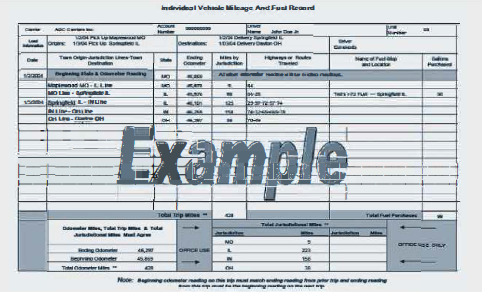
Not only do the trips need to be logged, but the fuel purchases need to be documented as well. You must obtain a receipt for all fueling and include it with your completed IVDR.
Make sure that any trips that you enter are always filled out in descending order and that your trips include all state and / or provinces that you traveled through on your route.
There are different routes that a driver may take, and most of the miles may be within one state or province. Whether or not the distance you travel is primarily in one jurisdiction or spread among several jurisdictions, all information for the trip must be recorded. This includes the dates, the routes, odometer readings and fuel purchases. By completing this document in full and keeping all records required by both the IRP and the IFTA, you will have ensured that you and your company are in compliance with all State and Provincial laws surrounding fuel and distance record keeping requirements.
The IVDR serves as the source document for the calculation of fees and taxes that are payable to the jurisdictions in which the vehicle is operated, so these original records must be maintained for a minimum of four years.
In addition, these records are subject to audit by the taxing jurisdictions. Failure to maintain complete and accurate records could result in fines, penalties and suspension or revocation of IRP registrations and IFTA licenses.
For additional information on the IRP and the requirements related to the IRP, contact your base jurisdiction motor vehicle department or IRP, Inc. the official repository for the IRP. Additional information can be found on the IRP, Inc. website at www.irponline.org. There is a training video on the website home page available in English, Spanish and French.
For additional information on IFTA and the requirements related to IFTA, contact the appropriate agency in your base jurisdiction. You will also find useful information about the Agreement at the official repository of IFTA.
Section 1.6
1.6 Medical Documentation Requirements
Any person applying for a CDL permit or the initial issuance of a CDL will be required to self-certify to a single type of commercial operation and provide a copy of their Medical Certificate and any applicable variance documents (i.e. Vision waivers, Skills Performance waivers, Diabetic waivers).
Effective June 18, 2025, all CDL Medical Certificates (med certs) submitted to FMCSA by the CDL customer’s Medical Examiner will be transmitted electronically to DDS. Therefore, DDS will no longer accept med certs by mail, fax, email, online, or in-person at DDS Customer Service Centers (CSCs) after June 18, 2025.
To update or renew your medical certificate and/or medical variance, first, receive an examination performed by a Medical Examiner listed on the National Registry of Certified Medical Examiners.
- The new medical certificate will be electronically submitted to DDS by FMCSA via the National Registry. You are not required to provide a paper med cert to DDS.
Read Frequently Asked Questions (FAQs) about the Medical Certification Integration Final Rule, National registry II (NRII).
If a person wishes to change their self-certification status, they will be required to visit a DDS Customer Service Center in person. The change may result in restrictions being removed or added to the license which will require a new license be issued at that time. Updated medical certificates and waivers must be submitted through your medical professional. Please note that a new self-certification form is not required each time an updated medical certificate is submitted.
Important information about your certificates:
- Each individual holding a CDL permit or CDL license will be responsible for providing new copies of Medical Examiner Certificates and any applicable variances ((i.e. Vision waivers, Skills Performance waivers, Diabetic waivers) prior to the expiration of those documents. Effective May 21, 2014, all new USDOT physicals must be performed by a qualified health professional listed on the National Registry of Certified Medical Examiners. Cards that are submitted without a National Registry number will not be processed.
- If you are required to have a "certified" medical status and fail to provide and keep up-to-date your medical examiner's certificate, you become 'not-certified'.
- Failure to provide valid medical certificates and / or variances may require retesting and additional fees to get your CDL privileges restored.
You will need to self-certify based on how you use the CMV. The following information will help you determine how you should self-certify. Do you, or will you, use a CDL to operate a CMV in interstate or intrastate commerce? Interstate commerce is when you drive a CMV:
- From one State to another State or a foreign country;
- Between two places within a State, but during part of the trip, the CMV crosses into another State or foreign country; or
- Between two places within a State, but the cargo is part of a trip that began or will end in another State or foreign country.
Intrastate commerce is The cargo on the vehicle originated in the state and will not leave the state and you do not meet any of the descriptions in the above bulleted list for interstate commerce.
If you operate in both intrastate commerce and interstate commerce, you must choose interstate commerce.
Once you decide you operate or will operate in interstate commerce or intrastate commerce, you must decide whether you operate (or expect to operate) in a non-excepted or excepted status. This decision will tell you to which of the four types of commerce you must self-certify.
You operate in excepted interstate commerce when you drive a CMV in interstate commerce only for the following excepted activities:
- To transport school children and / or school staff between home and school;
- As Federal, State or local government employees;
- To transport human corpses or sick or injured persons;
- Fire truck or rescue vehicle drivers during emergencies and other related activities;
- Primarily in the transportation of propane winter heating fuel when responding to an emergency condition requiring immediate response such as damage to a propane gas system after a storm or flooding;
- In response to a pipeline emergency condition requiring immediate response such as a pipeline leak or rupture;
- In custom harvesting on a farm or to transport farm machinery and supplies used in the custom harvesting operation to and from a farm or to transport custom harvested crops to storage or market;
- Beekeeper in the seasonal transportation of bees;
- Controlled and operated by a farmer, but is not a combination vehicle (power unit and towed unit), and is used to transport agricultural products, farm machinery or farm supplies (no placardable hazardous materials) to and from a farm and within 150 air-miles of the farm;
- As a private motor carrier of passengers for non-business purposes; or
- To transport migrant workers.
- Occasional transportation of personal property
If you answered yes to one or more of these above activities as the only operation in which you drive, you operate in excepted interstate commerce and do not need a Federal medical examiner's certificate.
If you answered no to all of these above activities, you operate in non-excepted interstate commerce and are required to provide a current medical examiner's certificate (49 CFR 391.45), commonly referred to as a medical certificate or DOT card, to DDS. Most CDL holders who drive CMVs in interstate commerce are non-excepted interstate commerce drivers.
If you operate in both excepted interstate commerce and non-excepted interstate commerce, you must choose non-excepted interstate commerce to be qualified to operate in both types of interstate commerce.
You operate in excepted intrastate commerce when you drive a CMV in intrastate commerce only for the following excepted activities:
- To transport school children and / or school staff between home and school;
- As Federal, State or local government employees;
- To transport human corpses or sick or injured persons;
- Fire truck or rescue vehicle drivers during emergencies and other related activities;
- Primarily in the transportation of propane winter heating fuel when responding to an emergency condition requiring immediate response such as damage to a propane gas system after a storm or flooding;
- In response to a pipeline emergency condi tion requiring immediate response such as a pipeline leak or rupture;
- In custom harvesting on a farm or to transport farm machinery and supplies used in the custom harvesting operation to and from a farm or to transport custom harvested crops to storage or market;
- Beekeeper in the seasonal transportation of bees;
- Controlled and operated by a farmer, but is not a combination vehicle (power unit and towed unit), and is used to transport agricultural products, farm machinery or farm supplies (no placardable hazardous materials) to and from a farm and within 150 air-miles of the farm;
- As a private motor carrier of passengers for non-business purposes; or
- To transport migrant workers.
- Occasional transportation of personal property.
You operate in non-excepted intrastate commerce when you drive a CMV only in intrastate commerce and are required to meet your State of licensure's medical certification requirements.
If you operate in both excepted intrastate commerce and non-excepted intrastate commerce, you must choose non-excepted intrastate commerce.
FMCSA Certifications (initial beside applicable statements)
Self-Certification Categories (Initial One)
Sample - Self-certification requirements (driver would initial A, B, C or D)
A, B - Medical Certificate needed.
A. Non-Excepted Interstate - I certify that I will operate or expect to operate in interstate or foreign commerce, that I am subject to and meet the FMCSA driver qualification requirements under 49 CFR part 391, and I am required to obtain a medical examiner's certificate. I also certify that I do not have an impairment of an arm, foot, or leg that interferes with the normal tasks associated with the operation of a CMV. (Medical Certificate needed)
B. Non-Excepted Intrastate - I certify that I will operate entirely in intra state commerce only and that I meet the FMCSA driver qualification requirements as defined in 49 CFR 391. I also certify that I do not have an impairment of an arm, foot, or leg that interferes with the normal tasks associated with the operation of a CMV.(Medical Certificate needed)
C, D - Medical Certificate NOT needed.
C. Excepted Interstate - I certify that I will operate or expect to operate in interstate commerce, but engage exclusively in transportation or operations excepted under 49 CFR §§390.3(f), 391.2, 391.68 or 398.3 from all or parts of the qualification requirements of 49 CFR part 391, and I am therefore not required to obtain a medical examiner's certificate. (Medical Certificate not needed)
D. Excepted Intrastate - I certify that I will operate in city, county, state, or federal vehicle only, and I am exempt from the FMCSA driver qualification requirements of 49 CFR 390.3(f). (Medical Certificate not needed)
Note: Please visit a DDS Customer Service Center to complete a new self-certification form if there is a change in driving status.