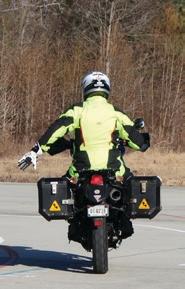
Section 1: Motorcycle Rider Licensing
Section 1: Motorcycle Rider Licensing
This Section Covers
- How to Obtain Your Motorcycle License – 1.1
- Required Motorcycle License Test – 1.2
- Rider Skills Test – 1.3
- Motorcycle Rider Education, Training, and License Test Waivers – 1.4
- Signs, Signals, and Markings – 1.5
Operating a motorcycle can be safe and fun when you act as a responsible rider. It also requires special skills and a heightened sense of awareness about other road users, traffic, and environmental conditions and a personal strategy to manage potential problems.
Studying this manual will not only help you pass your licensing tests, but it will also help prepare you to become a responsible and safe motorcyclist.
Take your time learning how to operate your motorcycle and get plenty of riding experience and training. You’ll need to be fully prepared for handling today’s traffic environment and reducing the potential for a crash.
1.1 – How to Obtain Your Class M Motorcycle License
You may obtain a Class M Motorcycle License if you:
- Are at least 17 years of age.
- Under age 18, a parent, legal guardian or responsible adult to sign the Form for Driver’s License/ID/Permit and complete the Responsible Adult Affidavit.
- Under age 18, a Certificate of School Enrollment (Form DS-1) must be presented.
- Pass required Motorcycle License tests, which include special road signs test, a special road rules test and an actual riding test on a motorcycle. (NOTE: The Motorcycle License test is waived if a 90-day test waiver is submitted for successfully completing the Basic RiderCourse or Basic RiderCourse 2.)
- Pass a vision test. If the vision test was administered and passed during the year in conjunction with another license issuance, the vision test may be waived.
- If the applicant meets the established requirements for a Class M License and also possesses a Class C or combination of other classes of permits, that license must be surrendered and a license containing the Class M will be issued. The applicant will not be given a refund for their remaining period of validity of the other license.
Class MP – Instructional Permit
An Instructional (Learner’s) Permit is issued for the purpose of learning how to operate a motorcycle on public roads or highways. An Instructional Permit is not a Motorcycle License.
All Instructional Permit applicants must pass a vision test and an examination of motorcycle knowledge. A Class M Instructional Permit (MP) is valid for 6 months. It is not mandatory for a Class M License applicant to obtain a Class M Instructional Permit (MP) before taking the Class M examination, although road test reservations are available only to those applicants who hold a Class M Instructional Permit (MP). Requirements for a Class M Instructional Permit (MP) are as follows:
- Must be at least 16 years of age.
- Applicants 16 years of age must comply with Joshua’s Law by successfully completing a DDS certified Georgia Driver Training/Driver Education Course consisting of at least 30 hours of theoretical instruction (classroom or virtual) and 6 hours of practical behind-the-wheel instruction (instructor or parent taught). A list of certified courses can be found online at https://online.dds.ga.gov/ddsgeorgiagov/locations/certified-driver-trai….
- Pass Vision Exam.
- Pass Motorcycle Knowledge Exam.
- If applicant is under 18 years of age, then a parent, legal guardian or responsible adult is required to sign the Form for Driver’s License/ID/Permit and complete the Responsible Adult Affidavit. The participating signatories also have the authority to request revocation of the permit at any time before the minor’s 18th birthday.
- Under age 18, a Certificate of School Enrollment (Form DS-1) must be presented.
MP Restrictions are:
- Motorcycle operation in daylight hours only.
- No passengers allowed.
- No limited access roadways.
- Safety equipment as prescribed by law.
Real ID License Documentation Requirements
DDS has been issuing Real ID compliant licenses and IDs since 2012. These procedures require that you bring additional documentation with you when you visit one of our Customer Service Centers (CSC).
To verify that you have a Real ID card, check the upper right-hand corner of your license/ID for either a Black star or Gold star.
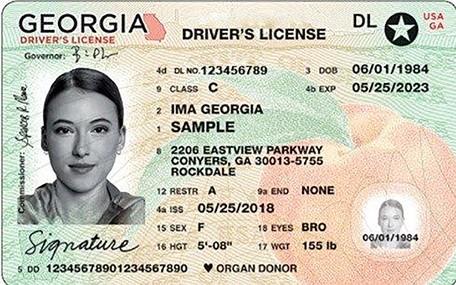
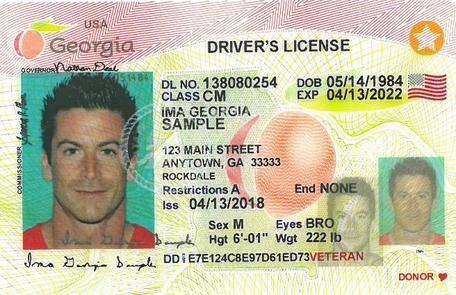
If you are a US Citizen and have a Real ID card, you will NOT need to bring your documents in again unless you are performing a name change, gender change or other services that require identification verification.
If you are new to Georgia or do not have a Real ID license, please visit the DDS website's Real ID Requirements page to identity which documents you will need to bring.
Section 1.1 - 1.3
Different Types of Vehicles
When looking at different types of motorcycles or motor-driven cycles, you will see the term “cc” along with a number: 250cc, 500cc, 750cc. The “cc” is an abbreviation for cubic centimeter, the volume of fuel mixed with air that powers motorcycles. Road-legal motorcycles, scooters, and even mopeds can have engines ranging from 50cc to more than 2,000cc. A motorcycle with a higher cc will weigh more and therefore have more power and be able to move more weight at faster speeds.
Motorcycles
Every motor vehicle having a saddle for the use of the rider, is controlled by handlebars, and designed to travel on not more than three wheels in contact with the ground, but excluding a tractor and moped (with engine size not exceeding 50cc), is defined as a motorcycle. Georgia law places all types of motorcycles (including scooters, motorbikes and mini-bikes with engine size 51cc or greater) into one classification. All are considered motor-driven cycles. A Class M License or a Class M Instructional Permit (MP) is required to legally operate a motorcycle or motor-driven cycle in Georgia.
Mopeds
A moped is defined as any motor driven cycle with an engine not exceeding 50cc (3.05 cubic inches). Mopeds are exempt from the provisions relating to the registration and licensing of motor vehicles.
Rules to operate mopeds on Georgia roads and highways:
- Must be at least 15 years of age and possess a valid driver’s license, instructional permit or limited permit.
- Must wear protective headgear (U.S. Department of Transportation (DOT) compliant motorcycle helmet).
- No tag is required.
- Must obey the same traffic laws governing drivers of motor vehicles.
- May not use limited access highways or other roadways where the minimum speed limit is above 35 mph.
1.2 – Required Motorcycle License Tests
Safe riding requires knowledge and skill. Licensing tests are the best measurement of the basic skills necessary to operate safely in traffic. Assessing your own skills is not enough. People often over-estimate their own abilities. It’s even harder for friends and relatives to be totally honest about your skills. Licensing exams are designed to be scored more objectively.
There are two ways to earn a motorcycle license. You can take a Georgia Motorcycle Safety Program Course where you will receive professional training in motorcycle handling (motorcycles are provided) as well as earn a License Test Waiver (if you successfully complete the course).
The License Test Waiver will allow you to bypass the knowledge test and the on-cycle skills test at a DDS Customer Service Center. See the section on the Georgia Motorcycle Safety Program in this manual.
The other method is to apply directly at a DDS Customer Service Center. To earn your license, you must pass a knowledge test and an on-cycle skills test (on your own motorcycle). You must also pass a vision test. If the vision test was administered and passed during the year in conjunction with another license issuance, this vision test may be waived.
Knowledge Test – you will need to take and successfully pass the Knowledge test. Knowledge test questions are based on information, practices and ideas from this manual. They require that you know and understand road rules and safe riding practices. NOTE: This requirement is waived for applicants who have successfully completed a Georgia Motorcycle Safety Program License Test Waiver rider education course.
Rider Skills Test – you will need to take and successfully pass an on-cycle skills test, which consists of a series of exercises designed to demonstrate your basic skills in operating a motorcycle. NOTE: This requirement is waived for applicants who have successfully completed a Georgia Motorcycle Safety Program 90-Day License Test Waiver rider education course.
You must furnish a motorcycle for the test and pass a safety inspection of the motorcycle by the DDS license examiner before the on-cycle skills test is given.
Basic vehicle control and crash-avoidance skills are included to determine your ability to handle normal and hazardous traffic situations.
The on-cycle skills test is designed for single-track vehicles (motorcycles) and multi-track vehicles (motorcycles with sidecars, and three-wheeled vehicles). Motorcycles with sidecars and three-wheeled vehicles maneuver differently than a two-wheeled single-track motorcycle. Vehicles outside of test standards may be required to use a car test route. Please be mindful on-cycle testing cannot be completed in an autocycle (i.e. three-wheel car-like vehicles).
Motorcycle Safety Courses
All riders are also encouraged to attend a rider education course which provides knowledge and hands-on training before receiving a motorcycle operator’s license.
Under the Georgia Motorcycle Safety Program (see section "1.1 How to obtain your class M motorcycle license), you may earn a License Test Waiver for your Class M Motorcycle License in the Basic RiderCourse and Basic RiderCourse 2. A 90-day license test waiver is provided to successful graduates.
Check out the rider education courses at The Georgia Motorcycle Safety Program.
You can also view rider education courses online at the DDS website.
1.3 – The Rider Skills Test
Safe motorcycle riding depends largely on your knowledge and skills. The skills for motorcycling require a lot of practice. If you have just learned to handle a motorcycle and have very little riding experience, then the most important part of learning to ride is still ahead.
You may wish to take a Georgia Motorcycle Safety Program rider education course that offers a License Test Waiver. For more information about locations and schedules, visit the DDS website.
The Rider Skills Test (RST) is used for both two-wheeled (RST-2W) and three-wheeled vehicles (RST-3W). The following pages highlight the testing patterns for both the two-wheel and three-wheel test.
Both tests consist of four riding evaluations that measure your control of the motorcycle and your hazard-response skills. The final two exercises involve speeds of about 15-20 miles per hour.
You will be scored on time/distance standards as well as path violations. The test may be ended early for point accumulation, committing an unsafe act, or failure to understand or follow instructions.
When you report for your test:
- You must have a DOT compliant helmet, eye protection and closed toe footwear.
- For safety, it is suggested that you wear long sleeves, long pants and gloves.
- You must furnish a street-legal motor-driven cycle for the test and pass a safety inspection of the motorcycle by the DDS license examiner before the riding test is given.
PLEASE NOTE: You have the right to cancel the test at any time. Inform the DDS driver examiner that you do not wish to continue the test. The examiner will explain the conditions for rescheduling the test.
The DDS license examiner also has the right to stop the test if you (a) fail to demonstrate basic control skills, (b) accumulate more than the maximum number of penalty points allowed, (c) commit any unsafe act (d) fail to understand or follow directions, or (e) fall from or drop the motorcycle.
Finally, all testing may be suspended due to inclement weather, equipment failure or other circumstances beyond the control of you or the examiner.
Section 1 Continued: Rider Skills Test for Two-Wheels
Rider Skills Test for Two-Wheels
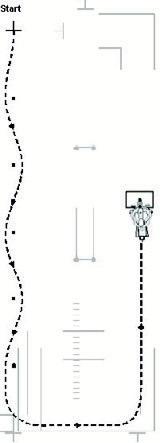
Evaluation #1: Cone Weave & Normal Stop
Directions:
From the start point ride to the right of the first cone, to the left of the second, and so on.
After passing the last cone, turn left and ride toward the opposite side of the course. Make a smooth, non-skidding stop with your front tire inside the box.
Points will accumulate if you:
- Stall during the exercise
- Put a foot down or hit/skip a cone during the weave
- Fail to stop with your front tire within the borders of the box
Evaluation #2: Turn From a Stop & U-Turn
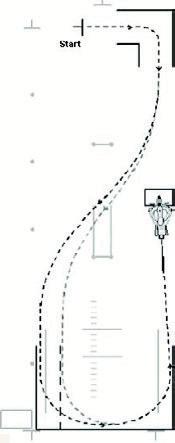
Directions:
From the start point make a right turn between the boundary lines.
After completing the turn, diagonally cross to the opposite side of the course and make a left U-Turn inside the painted box at the far end of the course. Do not touch the solid (24') line for motorcycles 600cc or more, or the dashed (20') line for motorcycles less than 600cc.
Stop with your front tire inside the box.
Points will accumulate if you:
- Stall during the exercise
- Put a foot down
- Touch or cross a boundary line
Evaluation #3: Quick Stop
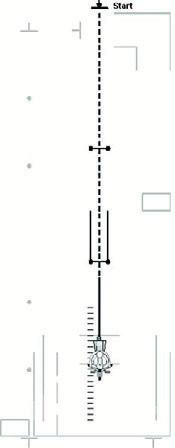
Directions:
From the start point accelerate straight up the path. Stabilize your speed between 12-18 mph by the time you reach the first line. Maintain a steady speed.
When your front tire crosses the second line, stop as fast as you safely can, using both brakes.
This test will be timed in order to determine your speed.
Points will accumulate if you:
- Stall during the exercise
- Fail to stop within the established standards
- Anticipate the stop (braking early) on 2nd attempt
- Fail to obtain the proper speed on 2nd attempt
Evaluation #4: Obstacle Swerve
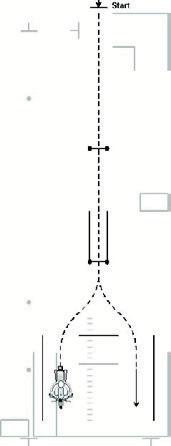
Directions:
From the start point accelerate straight up the path. Stabilize your speed between 12-18 mph by the time you reach the first line. Maintain a steady speed.
When your front tire passes the second line, swerve to the left or right as directed.
This test will be timed in order to determine your speed.
Points will accumulate if you:
- Stall during the exercise
- Touch or cross the obstacle line or sideline with either tire
- Swerve in the wrong direction
- Anticipate the swerve (swerving before second line) on 2nd attempt
- Fail to obtain the proper speed on 2nd attempt
Once you have successfully passed all of the required tests and met all other licensing requirements you may be issued a Class M Motorcycle License.
Section 1 Continued: Better Together
Better together.
The MSF (Motorcycle Safety Foundation) is proud to partner with Georgia Department of Driver Services to bring its cutting edge curriculum to the current prospective riders of Georgia.
The best first ride is an MSF RiderCourse℠.
Successful completion of the MSF Basic RiderCourse waives the DDS Motorcycle License test.
Get trained – get licensed.
msf-usa.org
Rider Skills Test for Three-Wheels
Evaluation #1: Left Turn & Normal Stop
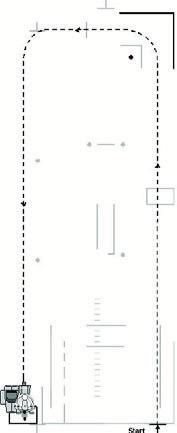
Directions:
From the start point ride straight ahead and make a sharp left turn between the boundary lines and the single cone marker.
Then ride toward the opposite end of the course. Make a smooth, non-skidding stop with your front tire inside the box. (Left front tire on vehicles with two front tires).
Points will accumulate if you:
- Stall during the exercise
- Touch or cross a boundary line
- Hit or skip the boundary cone
- Fail to stop with your front tire within the borders of the box
Evaluation #2: Cone Weave & Turn from a Stop
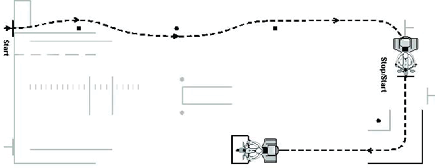
Directions:
From the start point ride to the left of the first cone, to the right of the second and to the left of the third.
After passing the last cone turn right at the end of the course and stop at the Start “T” facing the other side of the course. Then make a right hand turn between the boundary lines and the cone.
Make a smooth, non-skidding stop with your front tire inside the box.
Points will accumulate if you:
- Stall during the exercise
- Touch or cross a boundary line
- Hit or skip the boundary cone
- Hit or skip a cone during the weave
Evaluation #3: Quick Stop
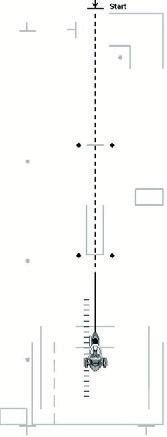
Directions:
From the start point accelerate straight up the path. Stabilize your speed between 12-18 mph by the time you reach the first set of cones. Maintain a steady speed.
When your front tire crosses the second set of cones, stop as fast as you safely can, using both brakes.
This test will be timed in order to determine your speed.
Points will accumulate if you:
- Stall during the exercise
- Fail to stop within the established standards
- Anticipate the stop (braking early) on 2nd attempt
- Fail to obtain the proper speed on 2nd attempt
Evaluation #4: Obstacle Swerve
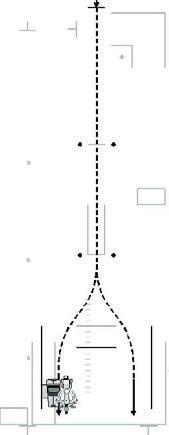
Directions:
From the start point accelerate straight up the path. Stabilize your speed between 12-18 mph by the time you reach the first set of cones. Maintain a steady speed.
When your front tire passes the second set of cones, swerve to the left or right as directed.
This test will be timed in order to determine your speed.
Points will accumulate if you:
- Stall during the exercise
- Touch or cross the obstacle line or sideline with your tire
- Swerve in the wrong direction
- Anticipate the swerve (swerving before second set of cones) on 2nd attempt
- Fail to obtain the proper speed on 2nd attempt
Once you have successfully passed all of the required tests and met all other licensing requirements you may be issued a Class M Motorcycle License.
Section 1.4
1.4 – Motorcycle Rider Education, Training, and License Test Waivers
The Georgia Motorcycle Safety Program (GMSP) offers rider education programs for every level of rider. GMSP also promotes motorist awareness programs, Share the Road campaigns, and focuses on highway safety issues affecting Georgia motorcyclists. The DDS directly operates 14 training sites throughout the state of Georgia. Rider training is popular and potentially life-saving. Without proper training, new riders are more likely to be involved in a crash. Experienced riders also can benefit from additional training to hone their crash-avoidance skills.
Three-Wheel Waiver Program
DDS is pleased to announce that the License Test Waiver Program has been expanded to include the Three Wheel Training Course. Since July 1, 2017, certified Motorcycle Training Schools that offer this training have the ability to issue a 90-day license test waiver upon successful completion of the course. This expansion is being implemented to enhance customer service, expand the Motorcycle Safety Program and to foster consistency.
Rider Education
When you take a Georgia Motorcycle Safety Program Course, you will receive professional training in risk management, motorcycle operation, and skilled riding techniques as well as earning a License Test Waiver (when you successfully complete a license test waiver course).
The License Test Waiver will allow you to bypass the knowledge test and the on-cycle skills test at a DDS Customer Service Center.
You may earn a License Test Waiver for your Motorcycle License in the Basic RiderCourse and Basic RiderCourse 2 License Waiver Course. A 90-day license test waiver is furnished to successful graduates. Courses are low-cost and provide professional training to assist riders in improving their skills in:
- Turning
- Traffic strategies
- Braking
- Evasive techniques
- And more!
Basic RiderCourse
- Self-paced eCourse and On-Cycle Training
- For new & experienced riders
- Motorcycle & helmet provided (at GMSP/DDS Training Centers)
- Earn a Motorcycle License Test Waiver
- $250.00: Enrollment fee (at GMSP/DDS Training Centers; see website for non-resident enrollment fee)
The Basic RiderCourse is the best way to prepare to obtain your motorcycle license. With no experience necessary, it is designed for beginning riders with no previous riding experience. We also recommend this course for riders who have not been on a motorcycle for a while. It combines practice riding on a closed course with classroom discussion.
GMSP provides training motorcycles and helmets at our DDS locations (there are additional riding gear requirements for students). If you own a scooter, you may ride your own scooter, 51-500cc, in the course. Scooter students must call GMSP at 678-413-8400 after registering and inform staff of their intention to use a scooter so we can notify your Coach.
The Basic RiderCourse offers complete and professional training. You will learn how to operate a motorcycle safely, with emphasis on the special skills and mental attitudes necessary for dealing with traffic. GMSP Coaches will start off with straight-line riding, turning, shifting and stopping.
You’ll gradually progress to cornering, swerving and stopping in shorter distances. In the classroom, you’ll learn about the different types of motorcycles, their characteristics, how they operate, and mental processes for riding.
The GMSP Coaches, all experienced motorcyclists, will advise you on what to wear for comfort, visibility and protection. You’ll find out how alcohol and other drugs affect your ability to ride safely. A very important segment of the course will introduce a strategy for riding in traffic, and how to deal with critical situations. The course concludes with a knowledge test and an on-cycle skills evaluation.
Once you successfully complete the course, you will receive a 90-day motorcycle license test waiver. To register, go to the DDS website, or call 678-413-8400.
Basic RiderCourse 2 – License Waiver
If you are an experienced rider without a motorcycle license or have been riding on a permit, earn your license now.
- 1-day Training
- Ride your own bike
- Earn a Motorcycle License Test Waiver with a Basic RiderCourse 2 - License Waiver (BRC2LW) course (some classroom)
- $100.00 Enrollment fee (BRC2LW) (at GMSP/DDS Training Centers). NOTE: The enrollment fee is $150.00 for out-of-state residents.
To register, go to the DDS website, or call 678-413-8400.
Advanced RiderCourse (ARC)
The ARC is a one-day course that complements a rider’s basic skills and helps with personal risk assessment. It focuses on the complex skills of self-assessment, personal risk management, and riding strategies.
The ARC includes a fast-paced classroom segment with several interactive activities to improve perception and hazard awareness. Range exercises enhance both basic skills and crash avoidance skills. Improving braking and cornering finesse is emphasized. The course is beneficial for riders on any type of street motorcycle. For details and a list of facts including required riding gear, visit Advanced Riders Course.
To register, go to the DDS website, or call: 678-413-8400.
Scooter Riders
Scooters have become a popular and sensible transportation option. Many people perceive them to be safer and easier to handle than a motorcycle. The reality is that any two-wheel vehicle takes a different skill set to maneuver on the street.
With that in mind, the GMSP welcomes scooter owners to participate in our License Waiver Basic and Basic 2 rider education courses. Scooter owners can now use their machine in a rider education program, and if successful, earn a license test waiver.
Of course, there are a few rules.
- Students use their own scooters. No scooters are provided.
- The scooter must be owned, registered, and insured by the student.
- The scooter must be street-legal and be 500cc or less.
- If the scooter is going to be ridden to and from class, a Class M Instructional Permit (MP) is required. (NOTE: Some classes are held after dark, and permit holders cannot ride after dark.) Students can trailer the scooter to the training location.
- Scooter students must call GMSP at 678-413-8400 after registering and inform staff of their intention to use a scooter, so we can notify your Coach.
Military Waiver
A military member or dependent will not be subject to taking a knowledge test or skills test as if he/she has completed a class offered by the Georgia Motorcycle Safety Program and/or recognized private sites.
Military members and dependents will be eligible to obtain a 90 day license waiver by submitting the following documents to the Motorcycle Safety Program:
- Motorcycle Safety Program Military Waiver application
- copy of a Motorcycle Safety Foundation, Basic RiderCourse, or Basic RiderCourse 2 completion card
- copy of your current Georgia driver’s license
- copy of your active, retired or dependent military I.D. and/or a copy of your DD-214, Mbr copy 4.
Once the documentation has been verified, a 90 day license waiver will be updated to his/her driving record. After receiving the waiver, the military member/dependent must visit their local DDS Customer Service Center within 90 days to obtain their Class M license. A military member or dependent that is not currently in the State of Georgia can go to the DDS website for information on renewing a license by mail.
Section 1.5
1.5 – Signs, Signals and Road Markings
Georgia law requires that all drivers, including motorcyclists, obey official highway signs and traffic control signals unless otherwise directed by a police officer or emergency worker.
Road Signs
Shapes of Signs
The State of Georgia uses seven basic shapes of signs to convey traffic control instructions. Drivers should know signs by their shapes and colors so that they may recognize them from a distance and begin reacting.
Octagon signs
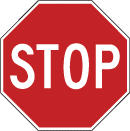
An Octagon (eight-sided shape) always means stop. When you come to it, you must make a complete stop at a marked stop line. If there is no stop line, stop before the crosswalk on your side of the intersection. If there is no crosswalk, stop at a point from which you can best see oncoming traffic. You must not start again until all pedestrians have finished crossing on the side of the roadway you are traveling on, and you have yielded the right-of-way to closely approaching traffic.
Triangle signs
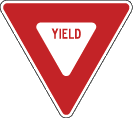
Triangle signs mean yield. You must slow down to a speed that is reasonable for existing conditions and stop if necessary. If you must stop, do so at a marked stop line, if it exists. After slowing or stopping, you must yield the right-of-way to other vehicles in the intersection or approaching closely on another roadway or auxiliary road leading into a major highway.
Round signs
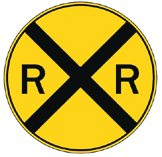
Round signs mean you are approaching a railroad crossing. This sign is posted a few hundred feet in front of the tracks and alerts you to slow down, look, listen and prepare to stop. Listen carefully for an approaching train. If the train is approaching, stop! Do not try to calculate whether you can “make it” across the track. Never try to beat a train through the intersection. Passing is prohibited at all railroad crossings.
Diamond signs
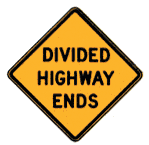
Diamond shaped signs warn of existing or possible hazards on roadways or adjacent areas. They are yellow with black words indicating the potential hazard, or black symbols visually describing the potential hazard.
Pentagon signs
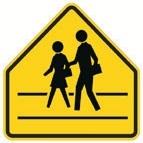
Pentagon shaped signs mean you are approaching a school zone and/or school crossing. When used, they will be erected not less than 150 feet nor more than 700 feet in advance of the school grounds or school crossing. (Warning signs can sometimes be fluorescent green in color.)
Horizontal rectangle signs
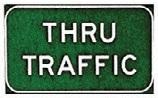
Horizontal Rectangle signs are generally used as guide signs. They show locations, directions, or other special information.
Vertical rectangle signs
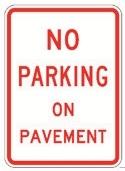
Vertical Rectangle signs are generally used for regulatory signs, which tell you what you must do. You must obey them in the same manner as traffic laws.
Regulatory Signs
Regulatory signs tell drivers what they may or may not do. Drivers, including bicyclists, must obey them in the same manner as traffic laws. Remember, a red circle with a red slash from upper left to lower right means “No.” The picture within the circle shows what is prohibited.
Do not enter sign
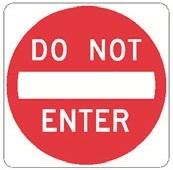
This marks a one-way road. If you are facing this sign traffic is coming toward you. You must not continue down the road.
Wrong way sign
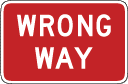
Motorist is approaching a one-way highway or ramp.
One way sign
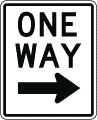
Motorist may travel only in the direction of the arrow.
Keep right sign
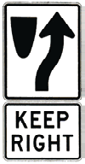
Traffic is required to keep to the right of medians or obstructions.
No U turn sign
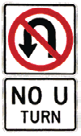
Motorist cannot turn around to go in the opposite direction at this intersection.
No right turn sign
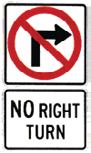
Motorist cannot make a right turn at this intersection.
Section 1.5 Continued
Speed limit 55 sign
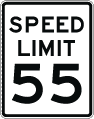
55 miles per hour is the maximum speed limit permitted in this area.
Reduced speed ahead sign
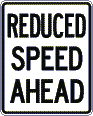
Motorist is approaching an area where a reduced speed limit has been established.
Slower traffic keep right sign
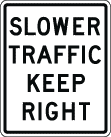
When two or more traveling lanes are available in the direction you are traveling, slower traffic should travel in the right (outside) lane(s).
No right turn on red after stop sign
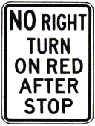
A right turn on red is prohibited, even after coming to a complete stop.
School speed limit sign
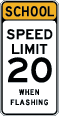
Motorist is approaching a school zone. A reduced speed limit is in effect when the yellow lights are flashing.
No bicycles sign
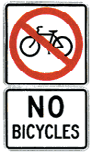
Bicycles are prohibited from entering this roadway.
No trucks sign
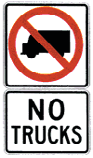
Trucks are prohibited from entering this roadway.
Warning Signs
Warning signs are usually yellow with black markings. (Warning signs can also be fluorescent green with black markings.) They alert you to conditions that are immediately ahead. There may be road hazards, changes in traffic direction or some other potentially hazardous situation that requires action on your part.
Sharp right turn then sharp left turn sign
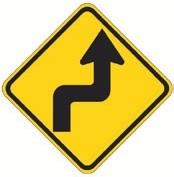
Sharp turn to the right and then sharp turn to the left.
Sharp right turn sign
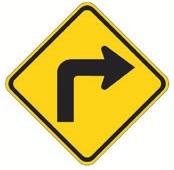
Sharp turn to the right.
Winding road sign
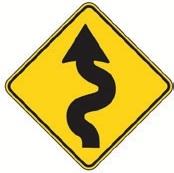
Winding road ahead.
Right curve sign
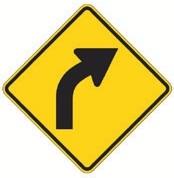
Curve to the right.
Side road enters ahead sign

Side road enters highway ahead.
Side road enters at an angle sign
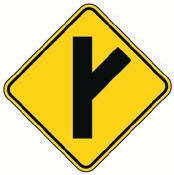
Side road enters highway ahead at an angle.
Section 1.5 Continued: More signs
Narrow bridge sign
The bridge ahead allows room for only two lanes of traffic. Approach with caution.
Soft shoulder sign
Shoulder of the road is soft. Drive on the shoulder only in emergencies.
Two way traffic sign
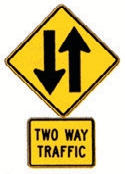
Warning that you are leaving a separated one-way highway and will soon be driving on a two-way highway.
Hill sign
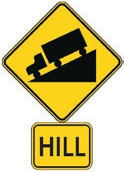
Steep hill ahead. Slow down and be ready to shift to lower gear to control speed and protect brakes from damage.
Road crossing ahead sign
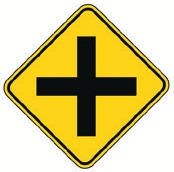
Another road crosses the highway ahead.
Dip sign
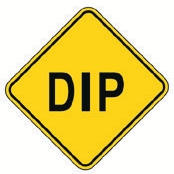
There is a dip in the road ahead. Slow down!
Divided highway sign
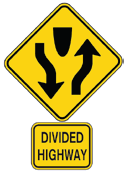
Divided highway begins. Prepare to change lanes or shift lane position.
Low clearance sign
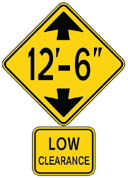
Approaching a low underpass. Do not enter if your vehicle or cargo exceeds the maximum height indicated on the sign.
Signal ahead sign

Presence of traffic signals at intersection ahead. Slow down!
Road ends sign
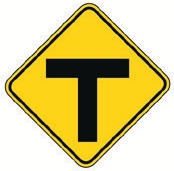
The road you are traveling on ends straight ahead. Slow down and prepare to yield or stop before turning right or left.
Bump sign
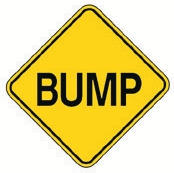
There is a bump in the road ahead. Slow down!
Divided highway ends sign
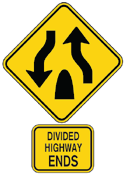
Divided highway ends. Prepare to change lanes or shift lane position.
Section 1.5 Continued: More Warning Signs
Merge sign
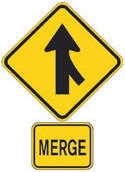
Traffic merging from the right. Prepare to allow traffic to safely merge.
Stop ahead sign
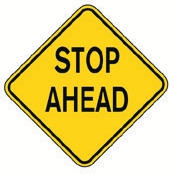
There is a stop sign ahead. Begin to slow down.
Yield ahead sign
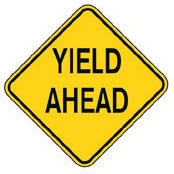
There is a yield sign ahead. Slow down and prepare to stop if necessary.
Slippery when wet sign
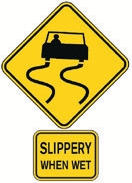
Roadway is slippery when wet. Remember, the first half-hour of rain is most hazardous.
No passing zone sign
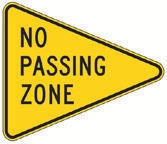
This sign is on the left side of the highway and marks the beginning of a no passing zone. Any passing maneuver must be completed before reaching this sign.
Pedestrian and animal crossing signs
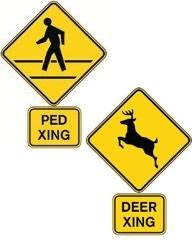
These signs alert drivers in advance of areas where animals, people, and vehicles may be crossing.
Lanes reduced sign
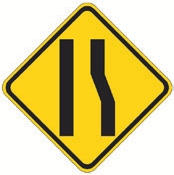
Number of lanes reduced ahead.
Watch for pedestrians in the crosswalk sign

Drivers must stop and stay stopped when pedestrians are in the crosswalk.
Construction and Maintenance Warning Signs
Road construction and Flagman signs
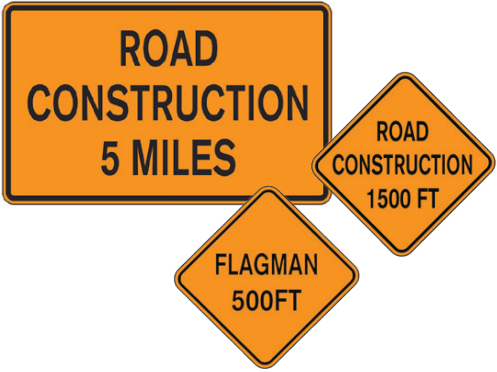
Warning signs for construction and maintenance projects are used to alert you to dangers ahead and give you enough time in which to adjust your speed accordingly. These signs are orange with black markings.
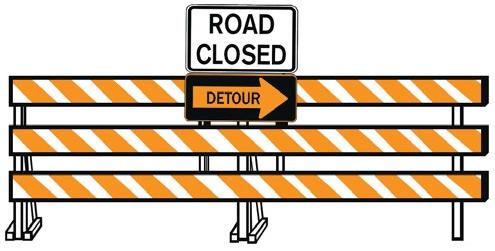
Road closed sign
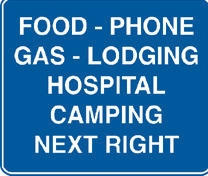
Service Signs
While traveling along Georgia’s highways, the following blue and white signs will give directions to service facilities.
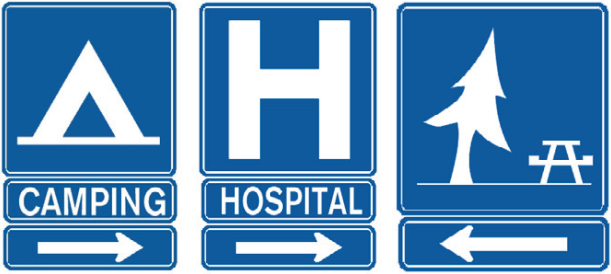
Camping, hospital and picnic area signs
Section 1.5 Continued: Guide Signs
Guide Signs
Guide signs may indicate what road you are on, and how to get to your destination. Many guide signs are rectangular, but some have other shapes. There are several different kinds of guide signs — route markers, information, destination, distance, and location signs. These signs may be accompanied by a “To” sign or an arrow, indicating the highway, facility, or location that can be reached by following the signs. Here are some examples:
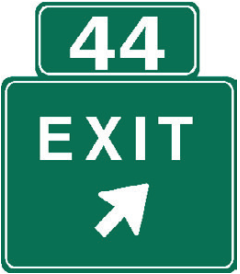
Exit 44 sign
Numbered interstate and highway signs
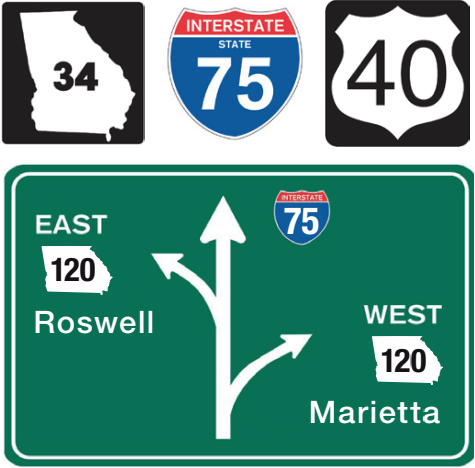
The numbers on these signs designate specific exits, interstates or highways.
Junction sign
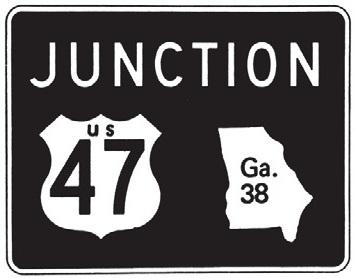
Intersection of U.S. Route 47 & Ga. Highway 38. These roads are going to cross or meet the highway you are traveling on.
Bike route sign
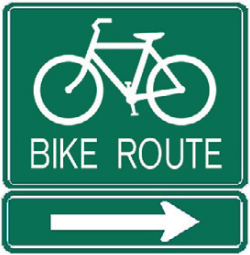
This sign marks an officially designated bicycle route. Be cautious of bicyclists while traveling on this road.
Milepost marker
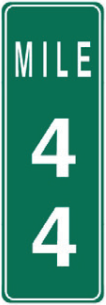
Milepost markers are placed each mile along the edge of the roadway from one end of the state to the other. Zero always starts at the south or west border where a route begins.
Caution sign
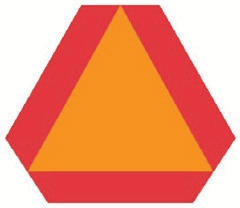
Caution - a vehicle displaying this emblem is a slow moving vehicle. A slow-moving vehicle is defined as any vehicle moving less than 25 miles per hour. They are required by law to display this emblem.
Parking sign
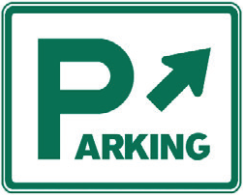
This sign means there is a public parking area in the direction of the arrow.
Railroad crossing sign
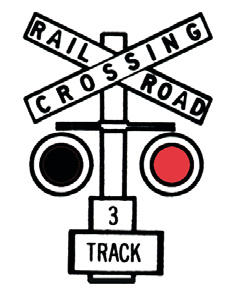
The cross-buck is placed at all railroad crossings. Yield to any approaching trains. Slow down, look and listen before crossing. A sign below the cross-buck indicates the number of tracks. A complete stop is required when a red light is flashing.
Traffic Signals and Signs
Traffic signals are placed at intersections to control the orderly movement of traffic and to prevent crashes. Drivers (including bicyclists) and pedestrians must obey these signals except when an officer is directing traffic. If a traffic signal is not functioning at all at an intersection, all drivers must treat the intersection as if a stop sign is posted for all directions. If a traffic signal is malfunctioning and flashing, drivers must proceed based on the color of the flashing signal they are facing: if the driver is facing a yellow flashing signal, the driver may proceed with caution; if the driver is facing a red flashing signal, the driver must stop and wait until it is safe to proceed.
Red light

A red light means you must make a complete stop before entering the crosswalk or intersection and wait until the light turns to green before proceeding.
Yellow light

A yellow light warns that the light is changing from green to red. Slow down and prepare to stop.
Green light
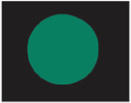
A green light means you may proceed if it is safe to do so after stopping for pedestrians and yielding to vehicles within the intersection.
Green up arrow
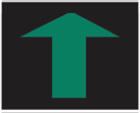
A green arrow means you may proceed carefully only in the direction the arrow is pointing after stopping for pedestrians and yielding to vehicles within the intersection. In this case you may go straight ahead only.
Green left arrow
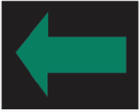
A green arrow, in this case, means you may turn in the direction of the arrow after stopping for pedestrians and yielding to vehicles within the intersection.
Yellow right arrow
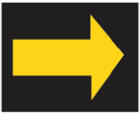
A yellow arrow may appear after a green arrow and warns you to clear the intersection.
Flashing red light
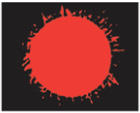
A red flashing light means you must stop completely (treat as you would a stop sign). Proceed with caution only after yielding the right-of-way to pedestrians and to other vehicles at the intersection.
Flashing yellow light

A yellow flashing light means you must slow down and exercise caution before proceeding through the intersection.
Flashing yellow arrow
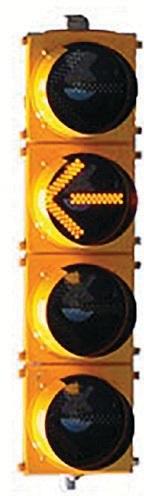
A flashing yellow arrow means you may turn left after yielding to oncoming traffic and pedestrians (oncoming traffic still has the green light).
Section 1.5 Continued: Lane Control Signals
Lane Control Signals
Some roadways are designed to accommodate different traffic demands during the day through the use of a reversible lane system. Appropriate travel lanes on a roadway utilizing a reversible lane system are indicated as follows:
No travel allowed signal
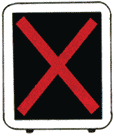
No travel allowed in this lane in the direction you are going.
Clear the lane or left turn permitted signal
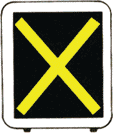
“Steady” — clear the lane “Flashing” — left turn permitted
Travel in lane signal
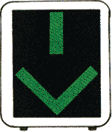
Travel in lane.
Overhead Lane Signs
Left turn only sign
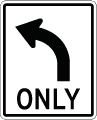
Left turn only.
Straight or left turn only sign
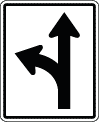
Straight or left turn only.
Right turn only sign
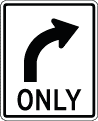
Right turn only.
Pedestrian Signals
Walk signal
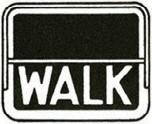
Leave the curb to cross the street.
Orange Don't Walk signal
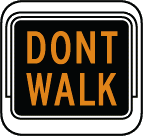
Do not leave curb.
Red Don't Walk signal
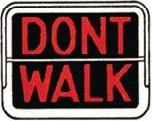
Flashing — do not leave curb, but complete walking across the street if already started.
Pedestrian safety guide sign
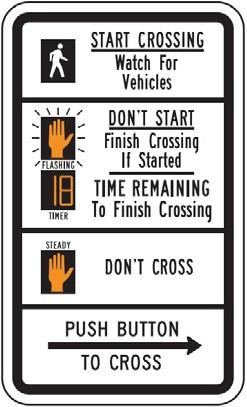
HAWK Signal
“HAWK’ stands for High-Intensity Activated Crosswalk. This signal is also known as a Pedestrian Hybrid Beacon (PHB), and it is designed to help pedestrians safely cross busy streets. Pedestrians push a button to activate the overhead beacon and stop road traffic. When WALK appears on the Pedestrian signal, pedestrians can cross the street.
Dark
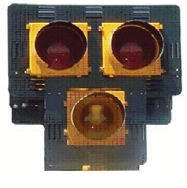
The HAWK remains DARK for traffic unless a pedestrian activates the push-button.
Flashing
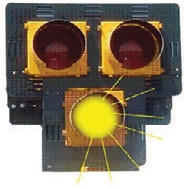
When a pedestrian presses the button, the signal is activated. Approaching drivers will see a FLASHING YELLOW signal for a few seconds.
Solid Yellow
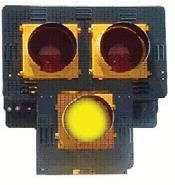
The flashing yellow is followed by a SOLID YELLOW signal, indicating drivers should reduce speed and be prepared to stop.
Solid Red
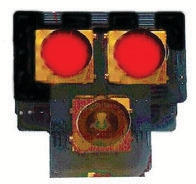
The solid yellow is followed by double SOLID RED signals, requiring drivers to stop.
Flashing Red
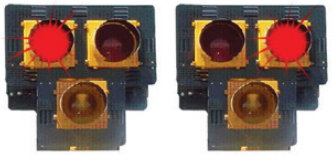
The double solid red signals are followed by alternating FLASHING RED signals. This requires drivers to come to a full STOP, and proceed when pedestrians have cleared the crosswalk. The signal will then go dark until activated again by a pedestrian.
Section 1.5 Continued: Pavement Markings
Pavement Markings
Pavement markings, like highway signs, are used to warn and direct drivers to regulate traffic.
Stop Lines
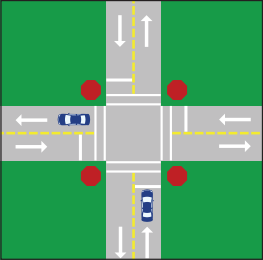
Stop lines are white lines painted across the pavement at intersections indicating the point beyond which your vehicle should not cross if you are stopping for a traffic control device. In urban areas the line is usually located about four feet before the crosswalk. Drivers must come to a complete stop at the stop line, when present, not at the actual stop sign or traffic signal.
Crosswalk Lines
These white lines are painted across, or partially across the pavement. Sometimes they will be painted in a ladder pattern. When pedestrians are in the crosswalks, they have the right-of-way over motor vehicles. Crosswalks are sometimes in the middle of a block in residential areas, and in some cases, a pedestrian crossing signal is located at the white line.
Railroad Crossings
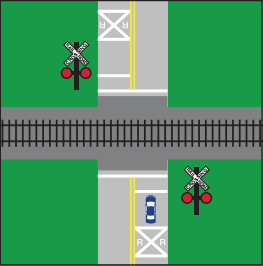
When a road is crossed by a railroad crossing, the pavement is usually marked with a large X and two R’s. At railroad crossings, a yellow line is always placed on the right side of the center line to prevent passing. The crossing is sometimes equipped with control arms and/or emergency lights, to warn drivers of approaching trains. The driver of the vehicle must stop if warning signals indicate a train is approaching
Center Lines
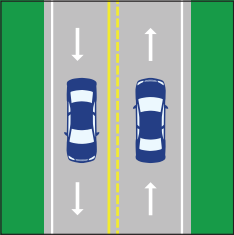
These are used to separate traffic moving in opposite directions on paved roadways. Broken yellow lines are used when there are only two lanes.
No Passing Lines
Single Lines
These single, solid yellow lines on two-lane roads indicate zones where passing is prohibited. They will be located on the right of the broken yellow line when they apply to the lane in which you are traveling. In some instances, both yellow lines will be solid, indicating it is not safe for passing in either direction.
Double White Lines
These are double white line (dashed or solid) pavement markings on roadways that indicate where vehicles can or cannot cross to access the adjacent lane. When the double white lines are dashed, vehicles are allowed to cross over to the adjacent lane. When the double white lines are solid, lane changes are prohibited.
Edge Lines
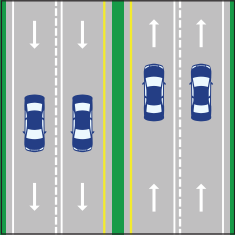
These are the solid white lines along the side of the pavement. They serve as safety guides, especially at night when it is difficult to see the edge of the road. A yellow edge line may be used on the left side to warn of narrow or raised medians.
Lane Lines
These are the white dashes that mark the individual lanes of travel on streets and highways having more than one lane for traffic moving in the same direction.
When there are four or more lanes with traffic moving in opposite directions, two solid yellow lines mark the center of the roadway. You may cross these lines only to make a left turn into or from an alley, private road, driveway, or another street. When traveling on a multi-lane road, stay in the right lane except to pass other vehicles traveling in the same direction.
Express Lanes
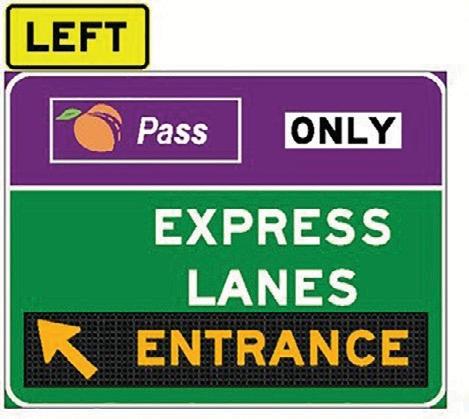
Express Lanes offer motorists the option to pay a toll to bypass congestion in certain areas on the interstate. All vehicles with no more than two axles or up to six wheels can use Express Lanes if they have a registered Peach Pass. When the vehicle travels through the Express Lane, the toll amount will automatically be deducted from the pre-established account. There are currently two sets of Express Lanes in Georgia.
The I-85 Express Lanes are HOT Lanes along I-85 North in Gwinnett County. They are open 24-hours per day. On the I-85 Express Lanes, registered transit, three or more person carpools, motorcycles, emergency vehicles, and Alternative Fuel Vehicles (AFV) with the proper AFV license plate are allowed to use the lanes toll-free.
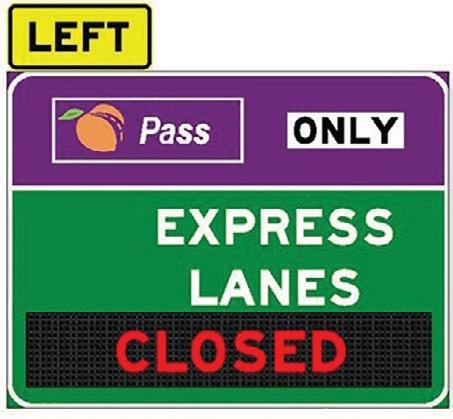
The I-75 South Metro Express Lanes are new, reversible lanes along 1-75 South in Henry and Clayton counties. Reversible lanes change directions during the day to provide additional travel options during peak travel periods. When the travel direction is being reversed, signs will show the lanes are closed. On the I-75 South Metro Express Lanes, all vehicles, including motorcycles and electric vehicles, are required to pay a toll. Public transit buses, registered vanpools and emergency response vehicles may use the lanes toll-free if they have a Peach Pass.
Express lanes entrance sign
Express lanes closed sign
Turn Lanes
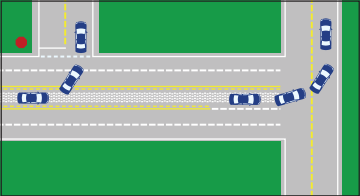
This lane, bordered by solid yellow and/or broken yellow lines, is in the center of streets and highways to make left turns. A motorist desiring to turn left should proceed to the turn lane just prior to making a left turn. Georgia law prohibits the use of this lane for any purpose other than making a left turn. You may enter this lane no more than 300 feet from the location of the left turn.
When a turning lane is provided for vehicles traveling in both directions, you should use extreme caution before entering the turning lane to make a left turn. There may be a vehicle traveling in the opposite direction also entering the turning lane to make a left turn. This is especially problematic in congested areas.
Bicycle Lanes
These are solid white lines typically located between the farthest right traffic lane and the curb or edge of the roadway. If there is a right-turn-only lane present, the bicycle lane will be located to the left of the right-turn-only lane in order to safely accommodate bicycles traveling straight through the intersection. Bicycle lanes may also be marked with painted symbols of a bicycle. Drivers of motor vehicles are prohibited from driving or parking in the bicycle lane, except to cross over it to make a turn. When crossing over a bicycle lane to make a turn, motorists must yield to bicyclists that are present.
Roundabouts
Roundabouts are sometimes used at intersections instead of stop signs. The purpose of a roundabout is to allow the intersection to handle heavier traffic flow without the need for a signal or a four-way stop. When entering a roundabout, traffic laws concerning right-of-way still apply. You must yield to other traffic that is already in the roundabout. You will always enter a roundabout to the right, and continue circling to the right until you have reached the roadway onto which you want to turn. When reaching the desired road, you will always turn right.
Traffic Striping
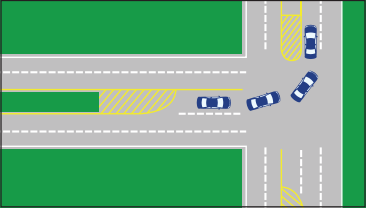
These markings, created by diagonal yellow lines, are on streets and highways indicating that the road is narrowing or there is an obstruction on the roadway. The area is similar to a triangle with solid yellow diagonal lines within the outside lines. Always keep to the right of these markings.
Section 2: Being in Shape to Ride
Section 2: Being in Shape to Ride
This Section Covers
- Alcohol, Other Drugs and Riding – 2.1
- Health – 2.2
- Emotions – 2.3
- Georgia’s Impaired Driving Laws and Penalties – 2.4
Riding a motorcycle demands your full attention. Responsible riders pay attention to the riding environment, identify potential hazards, look for escape routes and make good decisions.
2.1 – Alcohol, Other Drugs and Riding
Alcohol is a major contributor to motorcycle crashes, particularly fatal crashes. According to 2017 NHTSA statistics, 42% of motorcycle riders who died in single-vehicle crashes in 2015 were alcohol-impaired. Riding “under the influence” of alcohol or other drugs poses mental, physical and legal hazards for every rider.
By becoming knowledgeable about the effects of alcohol and other drugs, you will see that riding and alcohol/drugs don’t mix.
Effects of Alcohol and other Impairing Drugs
Alcohol and other drugs impair your:
- Judgment – Alcohol and other impairing drugs affect those areas of your brain that control judgment. You may not be able to make good decisions about the traffic conditions or how to protect yourself.
- Vision – Alcohol and certain types of drugs can blur your vision, slow your ability to focus and cause double vision.
- Reaction Time – Alcohol and other impairing drugs slow your ability to process information and impact your ability to react quickly to a situation.
How Alcohol Works
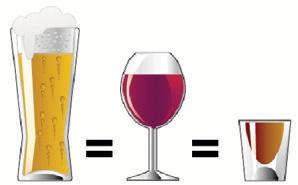
Unlike other beverages, alcohol is absorbed directly through the walls of the stomach and the small intestine, goes into the bloodstream, and travels throughout the body and to the brain. Alcohol is absorbed quickly and can be measured within 30 to 70 minutes after a person has had a drink.
A typical drink equals about half an ounce of alcohol. This is the approximate amount of alcohol found in:
- one shot of distilled spirits, or
- one 5-ounce glass of wine, or
- one 12-ounce beer.
What Affects My Blood Alcohol Concentration (BAC)?
BAC refers to the amount of alcohol contained in a person’s blood. In all states, an adult with a BAC of 0.08% or above is considered intoxicated. However, impairment begins with the first drink. Even under .08, you can be impaired and convicted for riding impaired. How fast a person’s BAC rises varies with a number of factors:
- The number of drinks. The more you drink, the higher the BAC.
- How fast you drink. When alcohol is consumed quickly, you will reach a higher BAC than when it is consumed over a longer period of time.
- Your gender. Women generally have less water and more body fat per pound of body weight than men. Alcohol does not go into fat cells as easily as other cells, so more alcohol remains in the blood of women.
- Your weight. The more you weigh, the more water is present in your body. This water dilutes the alcohol and lowers the BAC.
- Food in your stomach. Absorption will be slowed if you’ve had something to eat.
Don’t Drink or Don’t Ride
The safest and most responsible choice is to not drink and ride, because once you start, your judgment is affected and your ability to say “no” gets weaker.
If you plan on drinking, leave your motorcycle at home and find other transportation so you won’t be tempted to ride impaired. Or, call ahead to where you plan on drinking and ask if there is a secure place for you to store your motorcycle overnight so you can find an alternative way home – such as a taxi or designated driver.
There are no shortcuts to sobering up fast. None of the “remedies” you may have heard about – cold showers, hot coffee, or physical exercise – will make you sober faster. The only proven remedy to sobering up is time. Remember – your body can process about one drink an hour.
Other Impairing Drugs and Riding
All drugs may affect your ability to ride safely. This is true of many prescription, over-the-counter, and illegal drugs. If you are not sure if it is safe to take a drug and ride, ask your doctor or pharmacist about any side effects.
Never drink alcohol while you are taking other drugs. These drugs could multiply the effects of alcohol or have additional effects of their own. These effects not only reduce your ability to operate your motorcycle, but could cause serious health problems, even death.
2.2 – Health
There are many health conditions that can affect your riding, even little problems. Check with your doctor if a health condition could interfere with you operating a motorcycle.
2.3 – Emotions
Emotions can interfere with your ability to think, create mental distractions, increase risk-taking, create a lack of attention, and interrupt the ability to process information. You may not be able to give all your attention to operating a motorcycle if you are overly worried, excited, afraid, angry or depressed.
2.4 – Georgia’s Impaired Driving Laws and Penalties (OCGA §40-6-391)
First Offense
- Possible jail time up to one year, but not less than 24 hours
- Fine of $300 minimum, up to $1,000
- License suspension of up to one year
- 40 hours of community service, minimum mandatory
- Mandatory DUI Alcohol/Drug Risk Reduction Program at offender’s expense
- Mandatory 12 months probation
- Possible Clinical Evaluation at offender’s expense
- $210 license reinstatement fee
Second Offense within Five Years of First Offense
- Minimum mandatory 72 hours in jail, possible 90 days to one year
- Fine of $600 minimum, up to $1,000
- License suspension of 18 months
- Minimum 30 days community service
- Mandatory 12 months probation
- Mandatory DUI Alcohol/Drug Risk Reduction Program at offender’s expense
- $210 set license reinstatement fee
- A mandatory clinical evaluation at offender’s expense
Third Offense within Five Years of Second Offense
- Minimum mandatory 15 days jail time
- Fine of $1,000 minimum, up to $5,000
- License revocation for five years
- Minimum mandatory 30 days community service
- Violator’s name, photo, and address published in local newspaper at violator’s expense
- Declared as habitual violator, the license plate for his/her vehicle will be seized by the court and forwarded to the Georgia Department of Revenue
- Face a mandatory clinical evaluation at offender’s expense, and, if indicated, completion of substance abuse treatment program at the offender’s expense
- $410 set license reinstatement fee
Open Container Law
The law defines “open alcoholic beverage container” as any bottle, can, or other receptacle that contains any amount of alcoholic beverage and: (1) is open or has a broken seal; or (2) the contents of which are partially removed.
The law prohibits anyone from consuming any alcoholic beverage, or possessing any open alcoholic beverage container in the passenger area of any motor vehicle which is on the roadway or shoulder of any public highway. Only a person who consumes an alcoholic beverage or possesses an open alcoholic beverage container will be charged with an open container violation; however, a driver who is alone in a motor vehicle shall be deemed to be in possession of any open alcoholic beverage container. Anyone who violates this law is subject to a fine not to exceed $200.
This provision does not apply to any passenger in the passenger area of a motor vehicle designed, maintained, or used primarily for the transportation of persons for compensation or in the living quarters of a motor home or house trailer.
All Offenses of Georgia Impaired Driving Laws
The court shall order a person convicted of impaired driving to have an ignition interlock device attached to his/her vehicle for second and subsequent offenses within five (5) years, unless the court exempts the person due to financial hardship. This is required for any vehicle that is operated by the offender for a period of twelve (12) months.
License plates are also seized anytime a violator is convicted of a second or subsequent DUI within five (5) years.
Minors: In addition to court-imposed penalties, drivers between the ages of 15-21 who are convicted of impaired driving must delay obtaining their graduated license for 12 months. The BAC level for DUI for persons under 21 has been established at .02, while the level for adults is .08.
Section 2 Continued
Test Your Knowledge
- If you have only one drink before riding:
- You cannot be arrested for drinking and riding.
- Your riding skills will not be affected.
- It can affect your ability to operate a motorcycle.
- What percent BAC is considered legally intoxicated for adults:
- 0.02%
- 0.04%
- 0.08%
Answers
- C – see the section "What Affects My Blood Alcohol Concentration?"
- C – see the section "What Affects My Blood Alcohol Concentration?"
Proper Hand Signals
Double file
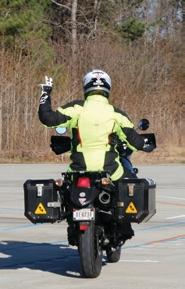
Single file
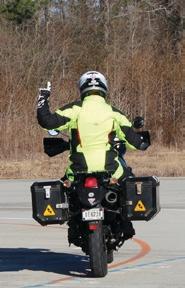
Obstacle on road—left
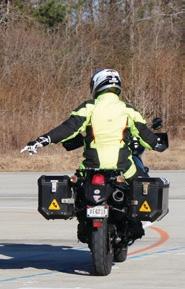
Obstacle on road—right
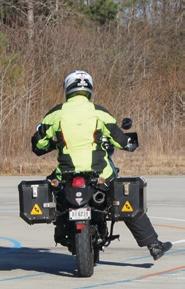
Pull over
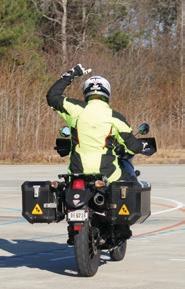
Right turn
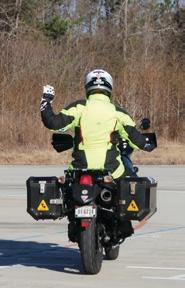
Left turn
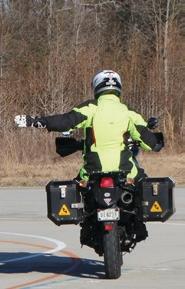
Slow down
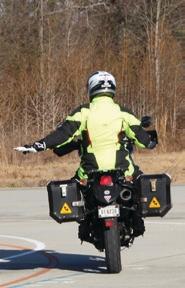
Speed up
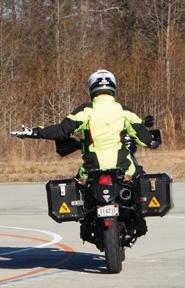
Stopping